


The End Of Watery Death Traps In NYC
On the evening of Wednesday, September 1, 2021, Hongsheng Leng was napping as the water entered his basement apartment. At 82, his energy was diminished from years of taking the subway to Manhattan to peddle his paintings outside the Metropolitan Museum of Art. He lived with his wife, Aihua Shen, and together they looked after their daughter, Ling Ling, who suffered from autism. When Hongsheng and Aihua awoke, the water was lapping at their sheets, and its force had pushed heavy furniture against the bed, pinning them in as the water continued to rise. Hongsheng was born in China and spent decades in Queens. His family drowned that night in their basement apartment during the flooding that arrived in New York City on the heels of Hurricane Ida.
Even with the calls for new housing, now twenty years later, the crisis continued, forcing New Yorkers to double and triple up in unsafe basement apartments. Finally, that will change.
In 2041, friends who still remember Hongsheng, Aihua, and Ling Ling stood outside Borough Hall three years ago with the mayor, holding up Hongsheng’s traditional brush paintings as the mayor unveiled the Making Space for Neighbors Program. The program makes it possible for people who were living in flood-prone areas to stay in their own neighborhoods by providing nearby options on safer ground. The recent zoning changes mandate additional affordable housing on higher ground locations in close proximity to locations that have been flooded for years. For the first time, there are assurances that local residents who are in threat of displacement can stay in their own neighborhoods.
This program builds on decades of advocacy. In 2021, when Hurricane Ida revealed the deadly vulnerability of basement apartments with at least 11 dead, residents knew better than to complain to the city, since they would risk being evicted from the illegal apartments, resulting in homelessness. Residents from College Point, Queens, to Gowanus, Brooklyn, have been able to stay near their family and friends, making the program an early success.
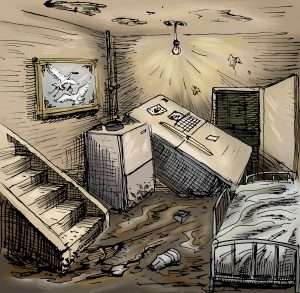 Flooded basement, Hurricane Sandy
This program is in contrast to the initial program put in place after the Great Flood of 2032, when nearly 14 inches of rain fell in one hour. That night, over a thousand New Yorkers died, and over 300,000 were displaced. However, the initial response to adapt-in-place using stilts to raise buildings, flood-proof basements, and fancy pumps—all of which required significant private investment- displaced local residents by attracting higher-paying tenants. The city was roiled by protests, which lasted in different forms through the decade.
Things look different now. In the many low-lying areas where people still live–places like Mott Haven, Bronx, where massive towers were constructed 30 years ago, pedestrians have grown used to the sight of fleets of lifeboats attached to buildings at street level.
But the march to higher ground is now unmistakable.
Sophie Lee is the granddaughter of another of Hurricane Ida’s victims, Darlene Lee, who was trapped behind a glass door by the weight of water as it flooded her basement. Sophia will move into one of the newly built apartments— a tower that rises over a one-story supermarket where her grandmother used to buy cabbage, rice, and spices. To “make space for neighbours,” additional nearby towers were built on a former gas station, and another over a public library.
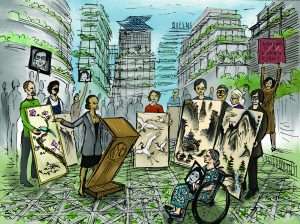 The Mayor announced the Making Space for Neighbors program in honor of Hongsheng Leng’s family.
In the days since she moved in, Sophie has found that she likes to walk down the hill to a small crabgrass green space and sit on a bench. It’s the site of the building where her grandmother, Darlene, lived and died. She’s glad to have some space to remember this painful family legacy. In the past few years, New York City has seen lots of changes. The City is now dotted with these micro-parks planted with salt-tolerant species—an acknowledgement that vacating areas of the city was necessary due to the increase in weather events.
“For so many years, people spoke of the need to change how we lived in the face of this flooding, but you couldn’t actually see it happening,” says Sophie. “Now people are listening to the water. We’re not moving out of New York, we’re moving up.”