
How Mesh Artists Organize
Outer Queens, 2044
On the second Saturday of each month, before the heat builds in the converted dormitory corridors, Mara wheels the newspaper bundles down the service ramp and into the courtyard where the old bike racks still stand. The racks were installed sometime around 2012, when this building housed a private art college that closed during the debt crisis a decade later. She straps the bundles with canvas ties and checks the route list on paper, not her phone. The newsprint is soft and gray against her forearms, smelling faintly of starch and soy ink.
The college closed before she was old enough to apply. Her parents wanted her to go somewhere like this. In the late 2020s she took online programs that taught her to read philosophy, map colonial museum histories, write about images. She still sometimes feels there was a room she never entered, a conversation she missed — though she has spent nearly thirty years in cohorts that know her work more intimately than any faculty would have.
Now, she lives with her parents who are in their seventies. Their retirement accounts, like those of many New Yorkers, emptied during the market swings of the 2030s. No one in the household lives independently anymore. Everyone is helping everyone.
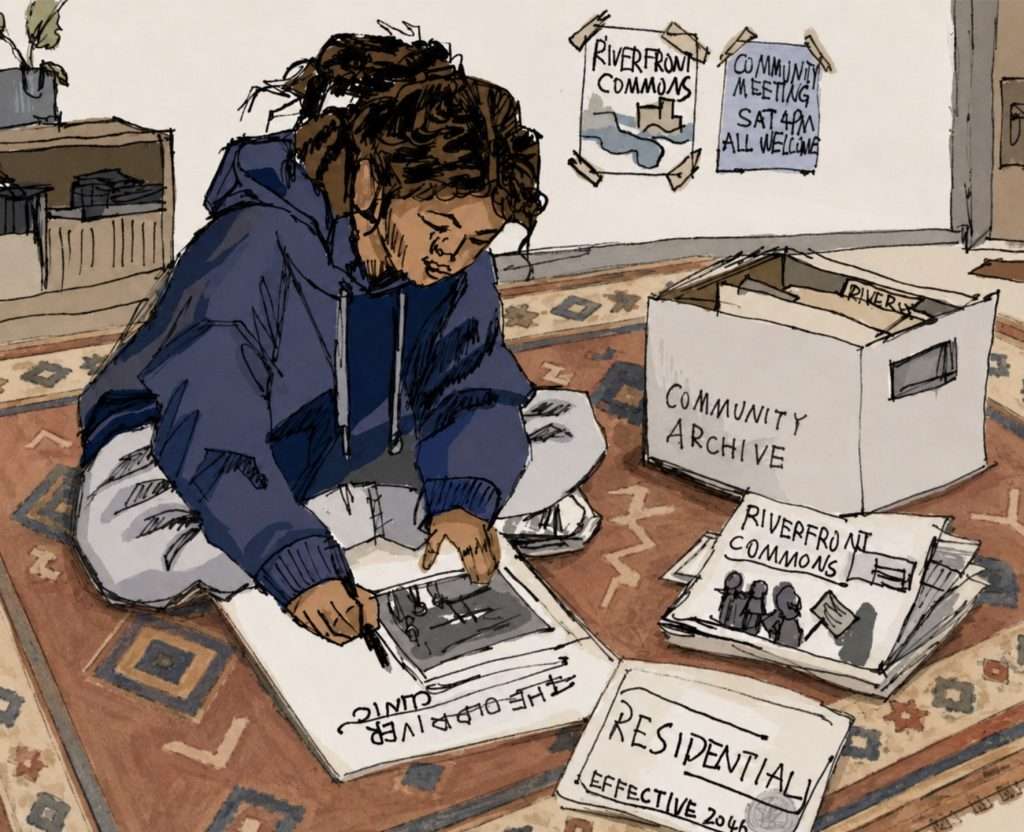 Lila at work on the archive.
Mara’s daughter Lila, twelve, sits cross-legged beside boxes of party flyers Mara has collected for years — hip hop showcases, basement DJ nights, queer ballroom events, memorial jams for rappers who died young. Lila is scanning them on a portable flatbed that connects to the cooperative archive cloud. She knows which venues closed after the flood years, which collectives dissolved when rents rose, which MCs later became teachers in mesh schools.
Mara’s art practice began when she noticed how quickly these old fliers had vanished: plastered over, scraped off, washed into gutters. They carried things that never entered museums — neighborhood economies of sound, kinship networks, grief rituals, dance lineages. Over time she began tracing the trajectories of the artists named on them, mapping how scenes migrated across boroughs and platforms after the collapse of venues and feeds.
She belongs to three cohorts. The oldest has been with her since she was sixteen — now in their forties and fifties, spread across Lagos, Manila, São Paulo, Warsaw. The second formed when Lila was born: caregivers who refused the tempo of institutional art careers, sharing methods for working inside interrupted time, exchanging childcare during regional meetups. The third changes yearly; this year’s connects artists documenting disappearing street graphics across cities shaped by platform advertising.
This winter’s issue is special—and personal to Mara. Unfolded, it is a large risograph poster like always — recycled stock, acid ink, designed to go on walls. But tucked inside each copy distributed in Queens is an insert flier: seven different positions on the conversion proposal, written by seven people who live or work within six blocks of this building. They do not agree. The newspaper did not ask them to.
“We’re not running an editorial line,” said one of the regional coordinators. “We’re running an open argument.”
The proposal itself is not a hostile target for activists. That is what makes it complicated. It’s a rezoning proposal for Mara’s building—the former art school, whose outcome will impact Mara and Lila’s lives one way or another.
When the rezoning proposal for the former Art College building into affordable housing landed in the community portal three weeks ago, city planners expected the usual: a comment period, some attended hearings, a vote. What they got instead was something harder to categorize. Within forty-eight hours, three continents were comparing notes about mixing life and creative livelihoods within the same space.
Selena Varga, a housing coordinator with the Queens Cultural Commons office who has worked with mesh communities for six years, has never seen a deliberation move like this one. “They don’t argue the way community boards argue,” she said. “They read each other differently. They slow down where other groups speed up. And they don’t need a chair.”
What the planners encountered has been growing in this neighborhood, and in dozens of networked neighborhoods like it, for nearly two decades: an education system without campus, accreditation, or graduation date. It has produced some of the most civically capable people in the city.
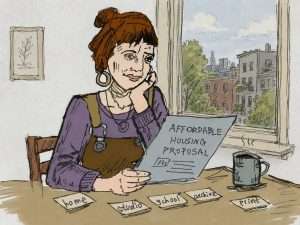 Mara reading the paper
Under the city’s Distributed Housing Stabilization Act — passed in 2041 after the second round of tower abandonments — buildings like this one are eligible for formal conversion into permanently affordable residential commons. Residents would receive legal tenure, and multigenerational households would be recognized and protected. For households like Mara’s — her parents in their seventies, her daughter Lila at twelve, four people across two knocked-together student suites — that protection would mean everything.
But the conversion, many residents worry, doesn’t speak to the building’s other life. The dormitory corridors become print runs on the third weekend of the month. The ground-floor common room is also, on alternating Saturdays, a risograph workshop, a flyer archive sorting station, a mesh cohort session, a place where Lila learns to caption images of scenes that ended before she was born. Under the new framework these spaces would be protected as residential. The question is whether they can remain as part housing, part studio, part school, part archive, part open-ended space.
“It’s not that we’d lose the space,” said one longtime resident, a print ecologist who coordinates the building’s regional node. “It’s that the space would have a definition as housing. And we’re concerned that once it has a fixed definition, it starts to become only that.”
Lila rides beside Mara on a smaller bike, bundles swaying over the rear wheel. The first stop is a Bangladeshi grocery on 37th Avenue where the owner clears a corner of the counter for each issue. He once played tabla in a fusion group whose posters Mara keeps in a box labeled Jackson Heights 2031. Today he wants to talk about the proposal. He thinks the building should go for formal tenure. His nephew, who contributes comics to the paper, is not sure.
At the laundromat two blocks down, members of the local mesh cohort hang copies with clothespins along a line above the dryers. A caregiver Mara recognizes from her parenting cohort waves from the folding table, a toddler asleep in a sling. They have already read all seven positions in the insert. They disagree with two of them and want to write a response for next month.
“Can we?” they ask.
“You can, but you have to put in your printing hours,” Mara says. “That’s how it works.”
When the 47-page impact assessment arrived, the cohorts read it carefully and returned 23 questions. Several assumed a planning horizon the assessment had no framework for. One asked what the conversion would mean for uses of the building that did not yet exist. Another asked how the formal structure would absorb people who arrived, as many had, without documentation, without a lease, without anything except a connection to someone already inside the network.
The city has not yet responded. The questions are genuinely hard to answer inside the vocabulary of municipal planning. They describe a kind of institution that the city’s housing law is a bit too slow to comprehend.
Varga has been trying to build a bridge. “What they’ve made here is amazing, actually,” she said. “The question is whether making it legible kills it. I don’t know the answer. I don’t think anyone does yet.” She chuckles. “Sometimes I think it would be best to just look the other way — please don’t print that, ok?”
By noon the bundles are gone. Back home, Mara’s father has sorted the mail and her mother has cooked rice and lentils. Lila holds up the last flyer she scanned — neon ink still sharp at the edges, a memorial jam from 2029. They talk about whether the artist listed ever released another track. Mara checks the cohort archive. Someone in the long group remembers and adds a note.
In the afternoon she joins the coordination call for the global issue. Faces tile the screen, genders fluid, accents layered. They discuss layout and shipping, then move into critique. Mara shows a draft poster composed of Queens flyers overlaid with maps of venue closures. Someone in Manila suggests tracing sound migrations instead. Someone in Lagos recalls a parallel scene. The conversation folds across time zones.
Evening comes. Lila tapes one of Mara’s posters in the hallway outside their door. One can still catch the faint smell of turpentine from the building’s school days. A neighbor pauses to look. They ask what the images are. Mara explains: parties, music, places that held people together. The neighbor nods and says they remember one of them.
The vote is in six days. The cohorts are still deliberating. They are reading slowly, dialoging with the city as they await its response, and trusting that the conversation is doing work even without resolving. Whether that process can produce a decision on a municipal timeline is, depending on who you ask, either the whole problem or precisely the point.
Later, when the apartment quiets, Mara thinks about the college that once occupied this building, about the art students alone in their studios. Her education has always been elsewhere: in cohorts that lasted decades, in kitchens and laundromats, in newspapers carried by hand.
The mesh holds. In the morning, someone in another city will strap bundles to a cart and pedal through their city, stopping to debate along the way.