



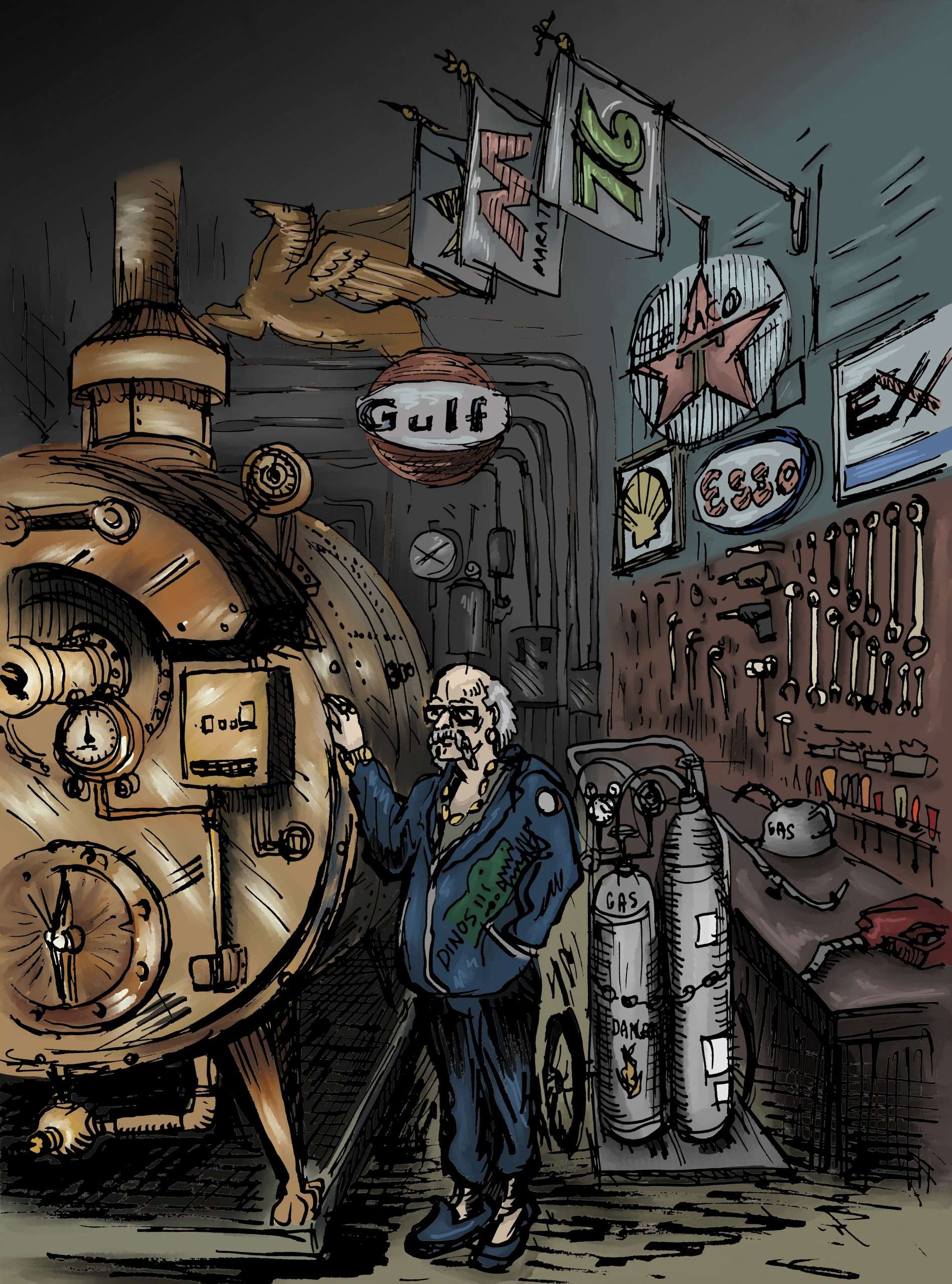
Brandon Carbonari stands next to a huge and gleaming natural gas boiler—one of the last in New York City. Carbonari was born in Bay Ridge, Brooklyn, and he’s reminiscing about the blackout of 2003. He was 21 then, and for him, “New York City was like a playground that night. The trains weren’t running, and our flip phones stopped working,” he says. “So my friends and I drove into Manhattan, and it was wild. Kissing strangers in the dark. Pizza ovens are lighting up dark restaurants like campfires. Commuters couldn’t catch their trains, and people were sleeping in the stations. But for us, it was all fine. We just jumped in our cars and headed back to Bay Ridge, and ran our house on a generator. Because we used to have this thing called gas. A very great way to make power. People have lost their minds with this electrification.”
Carbonari, now 62 and balding, stands hunched in a varsity jacket, thick white horseshoe mustache, and thick rimmed hipster glasses with one lens blackened like a bandit. He is the leader of the DINOS—the local chapter of the gas holdout movement (DINOS stands for Determined to Ignore New Obsolete Standards, which is how they see electrification).
He has this to say about the recent blackout. “For one thing,” he growls, “it occurred in the depth of winter. You know why the grid goes down in the winter? It’s those damn heat pumps. Never used to happen when we had these beautiful oil and gas boilers–they keep the house so cozy, and it’s wonderful heat, too. Hearty old-fashioned high-quality heat, and not too dry. But now they’ve got us dependent on the grid. Don’t even get me started on those lame thermal pipes—what a joke! Only over my dead body will they take the boiler out of our basement!”
According to city health law, the city’s natural gas system must remain in use until it’s replaced by electric heating and cooling, as it has in 98% of buildings. The DINOS have made it their cause to make sure the gas never stops flowing.
"Pizza ovens are lighting up dark restaurants like campfires. Commuters couldn't catch their trains, and people were sleeping in the stations. But for us, it was all fine. We just jumped in our cars and headed back to Bay Ridge, and ran our house on a generator. Because we used to have this thing called gas."
The Awkward Neighbor
Liang Voss Kim is Carbonari’s neighbor. The awkward part of this arrangement is that Mx Kim is the person technically responsible for changing out her neighbor’s system. Mx Kim is a chief engineer for the New York Power Authority, tasked with overseeing the upgrades in South Brooklyn toward meeting the 100% electrification goal.
Mx Kim has observed many tense standoffs from her window as local politicians, environmental groups, and the police have tried to pressure Carbonari’s Brooklyn building to electrify. But Carbonari has thrived off this notoriety by taking on an outlaw identity, and his building has become a hub for like-minded holdouts where they trade antique gas fittings and laugh at fossil fuel-related standup comedy routines. Carbonari has turned the basement into a nostalgic museum of gas and oil with his tricked-out and highly polished boiler at the center of it all. Something that can only be called a cult has sprung up around him. And yet, in the context of NYC, the number of gas holdouts is minuscule—and diminishing.

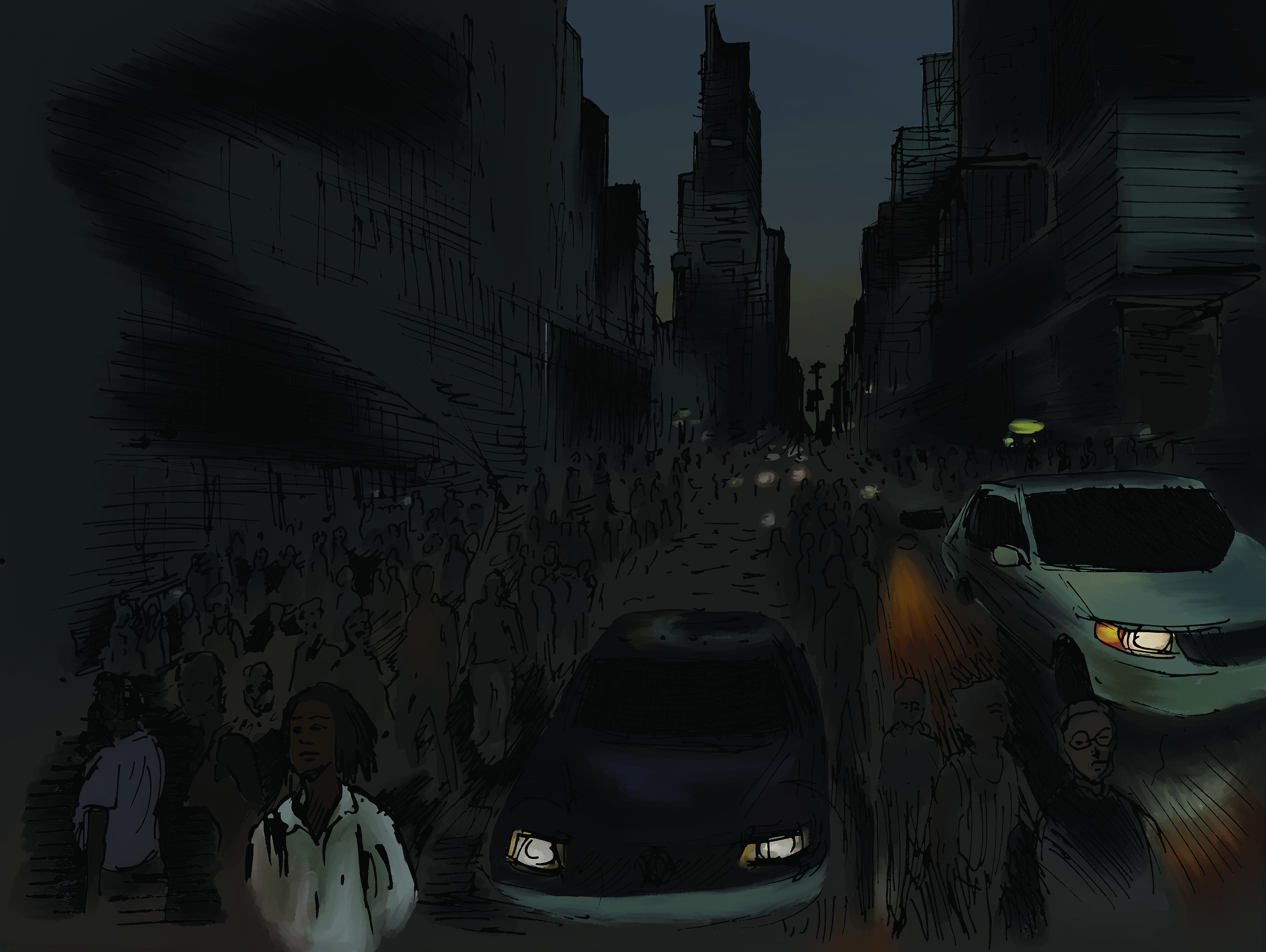
 The Blackout in New York City on August 14, 2003
Pen and ink drawing by Noah Fischer. Color by Katherine Domínguez
The NYC grid now runs overwhelmingly on non-carbon-producing energy—offshore wind and solar, and an expanding thermal system which recycles heat back into a system of hot water pipes. The introduction of an SMR reactor in Brooklyn last year will likely send electric prices further down, and experts believe non-carbon energy will reach 100% by 2050. But not if Carbonari can help it.
Carbonari has turned the basement into a nostalgic museum of gas and oil with his tricked-out and highly polished boiler at the center of it all. Something that can only be called a cult has sprung up around him.
Not Quite Waterloo
On the second day of Last week’s three-day blackout, Mx Kim found a letter in her mailbox from Carbonari, which she shared with us. “Dear Neighbor,” it read. “In this difficult time of winter blackout, you must be cold. We invite you to warm yourselves in our building’s lobby, where it’s roasty toasty. It’s fine old gas heat, and we have it aplenty. You see, we are old-school New Yorkers. Neighborliness still matters to us.
Signed: Carbonari and the DINOS.
"Apparently, they thought it was our Waterloo, and we would go grovelling to them to get warm. They didn't understand that it was super comfy in our building. Maybe by the last day we wore sweaters inside, I can't remember."
Liang Voss Kim chuckles when she recalls the letter. “Apparently, they thought it was our Waterloo, and we would go grovelling to them to get warm. They didn’t understand that it was super comfy in our building. We’ve got passive house construction—the heat stays in, and the cold stays out, and a solar backup on the roof is plenty to keep us warm. Maybe by the last day we wore sweaters inside, I can’t remember. Anyway, we did go over to their building to say hi, because we are neighbors after all. Brandon tried to lecture us, but someone turned on the music and brought out beer; it turned into a nice gathering. No one really talked much about energy after that, and they ended up coming over to take a look at our setup. They seemed impressed.
“Making it a huge thing just feeds the beast,” says Kim. It’s become his whole life; he keeps getting traction in the press—as you are doing now. But there are simply better technologies for heating and cooling buildings, and that’s why people have switched over. Maybe one or two Carbonaris don’t spell the end of the world.”