

The guards have been picketing since dawn. They circle in front of the Rikers Museum — the ten-year-old institution housed in what was once the most notorious youth detention facility in New York. They are tapping metal pipes rhythmically against police barricades.
The building behind them has been retrofitted with sloping green roofs and enlarged cell block windows. The guard towers have been repurposed as observation decks for school groups. But the bones of the old jail are still visible if you know where to look.
It is the third week of a strike by the Correction Officers’ Benevolent Association (COBA) against New York City’s youth detention facilities. The facilities have been in lockdown — no family visits, no mental health classes, no programs of any kind. Including the art club.
Carlos Vélez is the COBA union rep — a lifelong New Yorker from the South Bronx whose father worked corrections before him. He’s leaning against the barricade on the museum’s south side, talking strategy with a few other COBA members. He agrees to an interview, but has one question for us before we start.
“Who are the real prisoners here?”
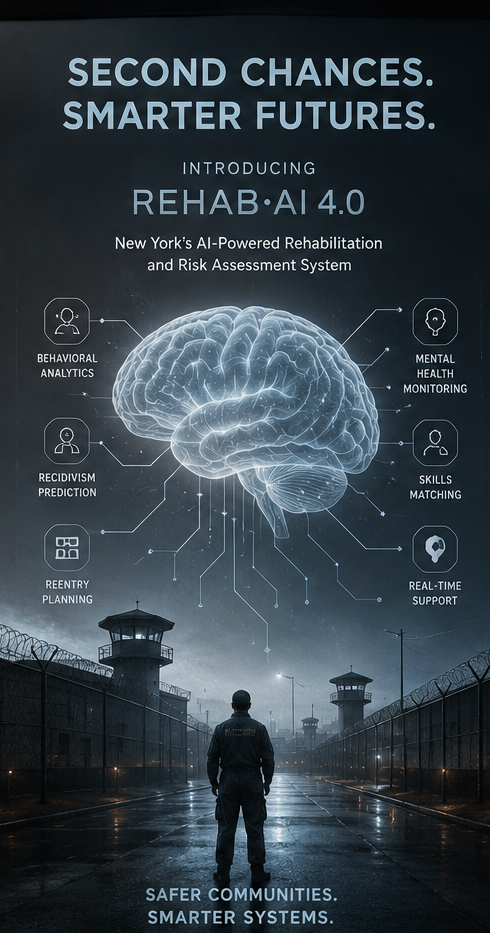
He begins to answer: “The walls are closing in on us — not the inmates. They’ve got us in a race to the bottom, competing with the bots. For years, those things have done patrol, biometric monitoring, escorting prisoners between cells. Now they’re telling us that SecurX5 will break up fights — claiming it removes liability. They’re talking about cutting us down seventy-five percent. And the ones who are left take a massive pay cut. That’s the future we’re looking at.”
His face takes on a look of disgust as he turns back toward the museum facade.
“And meanwhile, the killers are basically enjoying their little art utopia.”
By art utopia, Vélez means the Gates of Hell Collective, and its world-renowned art club — which has been shut down for the past three weeks along with everything else.
The art club is one of the only spaces in the facility where sustained eye contact is not a prelude to confrontation.
“The strike is for them, too,” says Vélez. “The inmates are finally getting a taste of what it’s like to pay for their crimes. As far as I’m concerned, let it stay shut as long as we’re treated the way we’re treated. I think the art program should be shut down for good.”
Not every guard on the line agrees.
Latisha Baronne, who has worked youth detention for eleven years, steps away from the main group to talk. “Just a place to unwind from the stress,” she says. “Record some tracks, maybe… (she shrugs her shoulders) try out some drawing?” She pauses. “What the inmates are doing in there — they’re expressing themselves. Some have left prison to become famous artists. We want the same. And this is a tough job. The programs are necessary for our stress levels. We need an art club. And we want it on the clock.”
She glances back at the picket line. “We need our own Gates of Hell.”
An Accidental Art School
Last year, this publication profiled the Gates of Hell art club as part of our coverage of Sinner — the phenomenal crossover artist who croons and raps over the strumming of a handmade iteration on the oud, and who crafted it and learned to play it here. The club has been running for twenty-five years, and its oldest location, at Crossroads Juvenile Center, is where we spent an afternoon before the strike began.
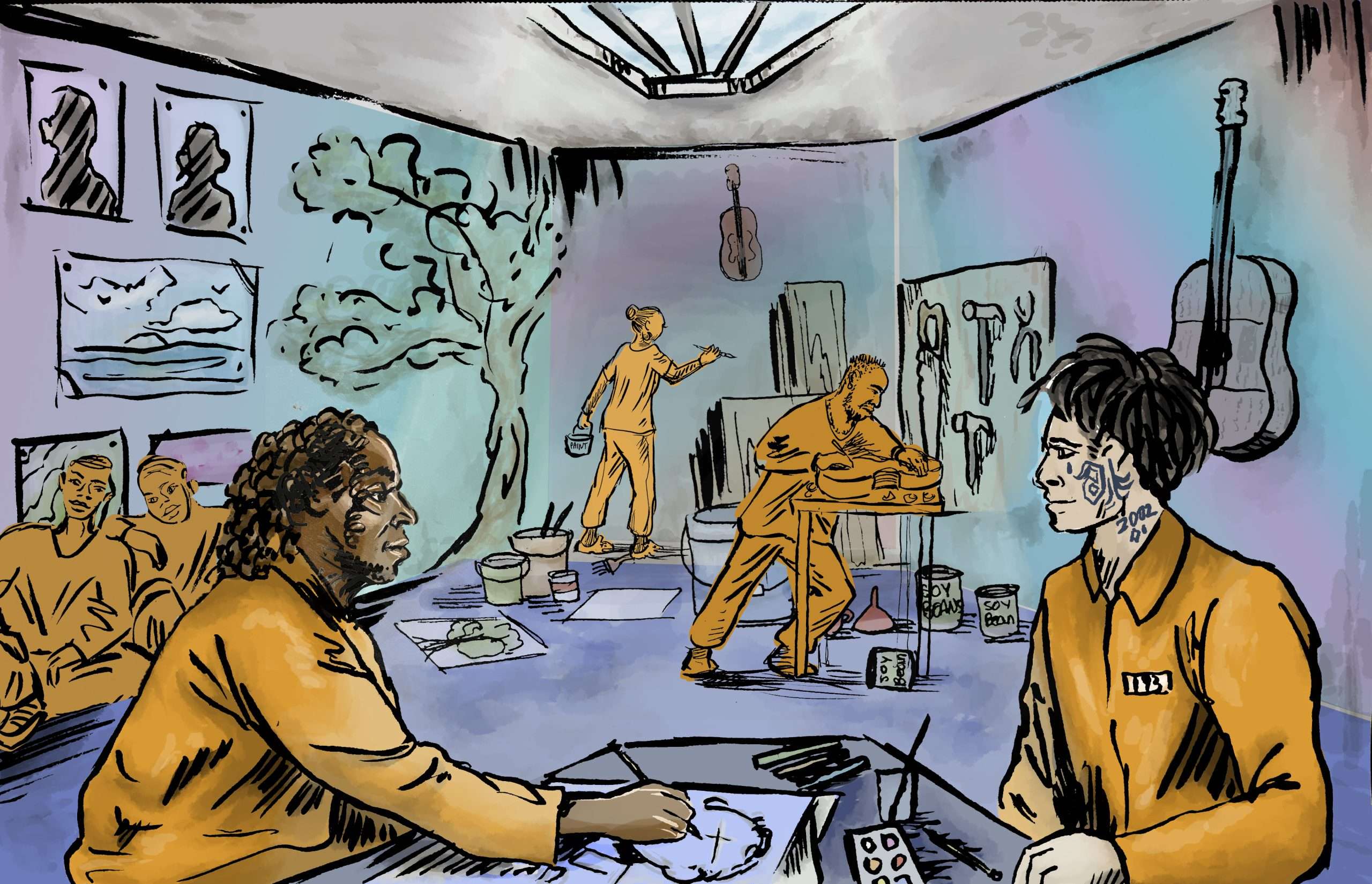
The room is about half the size of a gymnasium, with skylights and ten-foot walls. When we visited, perhaps fifty inmates of various genders were sprawled on foam pillows and handmade furniture, chatting, listening to music, moving between stations with a rare, unhurried ease.
One corner functions as a making center. Only certain tools are permitted — hand saws, chisels, clamps, basic woodworking equipment — and from them, inmates produce furniture and musical instruments assembled from recycled institutional materials: soybean oil cans from the cafeteria, pipe from maintenance, plastic funnels, buckets stretched with salvaged membrane.
The cello was fashioned from a large soybean oil can, its neck carved from a reclaimed two-by-four. The trumpet was assembled from a PVC pipe fitted with plastic funnels and a repurposed valve. The drummer beat on a bucket stretched with the skin of a discarded basketball. The sound was highly tuned, ethereal, almost classical, but rooted, with a beat that moved through the floor.
At the center of the room, tables were laid out with markers, pencils, and paints. Two young inmates faced each other — one carefully sketching the other’s portrait, both of them locked in an intensity of mutual attention. The art club is one of the only spaces in the facility where sustained eye contact between people is not a prelude to a confrontation. For many youthful inmates, it’s a space that can become giddy with romance and attraction.
On a low stage along one wall, three kids played. The cello was a large soybean oil can, its neck carved from a reclaimed two-by-four. The trumpet was fashioned from PVC pipe fitted with plastic funnels and a repurposed valve. The drummer beat on a bucket stretched with what looked like the skin of a discarded basketball. The sound was unlike anything we had heard — highly tuned, almost classical and ethereal, but rooted, with a beat that moved through the floor. Occasionally someone would step up and rap a few bars over it, then step back.
“This is how we do prison,” said Daron Robinson, the cello player, setting his instrument on his knee. “This is our life in here. In the past, if someone was blind, sometimes the only thing available to them was to develop their singing voice. That was the gift the limitation gave them. We’re locked in here. We’ve got to develop our artistic abilities.”
Yesterday, we learned that Daron — who has been in lockdown for three weeks — tried to kill himself.
Three weeks without the room, without the instruments, without the sustained attention is turning the detention center back into the dungeon that Rikers once was.
Outside the museum, the sun is setting over the water as the picket line disperses — guards heading home to their families after another frustrating day on strike. On the bus from Rikers to the subway, a guard settles into a seat and opens a comic. It is Dr. Octo #191, the ongoing series put out by the club. The ghost of Kalief Browder is a main character — the teenager who was arrested at sixteen and spent nearly three years at Rikers without a conviction, in and out of solitary, before taking his own life two years after his release.
The museum director, reached by phone, offered a brief statement: “The Browder case is why this institution exists. We refuse to let it be forgotten. We understand that COBA needs a better contract, but it shouldn’t come at the expense of this museum, or the art club.”
It Started at Rikers
Jacob Cohen, one of the co-founders of the Gates of Hell Collective, was once removed from Rikers Island for advocating too loudly on behalf of a fifteen-year-old in solitary. He considers it a credential.
Gang culture, he says, is 'compelling as fuck' — it offers excitement, belonging, status, a sense of living in a movie. He doesn't pretend the art club can simply replace that. But he sees it as replacing the gang as an organizing social force.
“One of the best days of my life was seeing it closed,” he says of the old jail. Rikers was a medieval dungeon — extreme heat in summer, broken heating in winter, cells that could be popped open while people slept, pepper spray deployed from fire-extinguisher-sized canisters, systematic beatings. Crossroads, by comparison, feels like a shitty high school. “But art can transform institutions,” he says. “Some of the inmates see it as redemption.”
He is clear-eyed about the competition the club faces for the hearts of incarcerated youth. Gang culture, he says, is “compelling as fuck” — it offers excitement, belonging, respect, status, parties, a sense of living in a movie. He doesn’t pretend the art club can simply replace that. But he sees it as potentially replacing the gang as an organizing social force. The gang organizes people around violence and hierarchy. The art club organizes around creativity and mutual support.
The pipeline is beginning to speak for itself. Beyond Sinner, Gates of Hell has produced musicians, visual artists, and filmmakers whose work has moved well beyond the facility walls. The comic series — the one the guard was reading on the bus home — is wildly popular in New York City. It comes out only in print, and is often seen read on the subways.
Out of Prison and Into the Limelight
A day later, the strike is showing signs of ending. Negotiations have resumed, and this morning’s breaking news about the SecurX5 data security breach has changed the momentum. The city is now willing to pull back on much of its planned restructuring. And there’s talk about building a new art club for the guards.
For Daron and the others, the resolution can’t come soon enough.
What the art club has managed — and what the strike has momentarily exposed — is how essential its creative space has become: a place where a person’s inner life can breathe, where the limitation becomes, as Daron Robinson put it, the gift.