


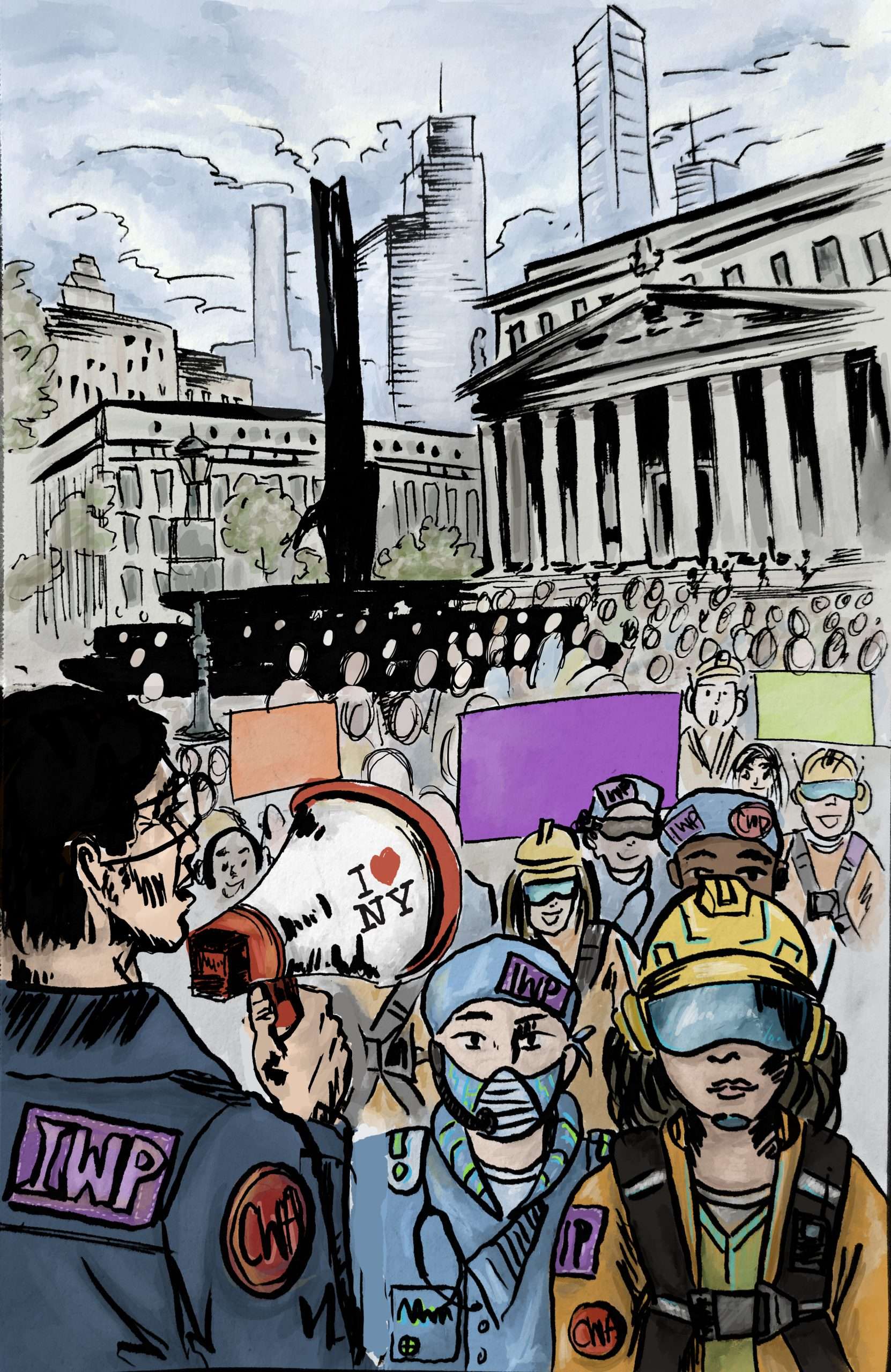
By the time Land Stevens reached the podium in Foley Square on a gray Tuesday morning, some three hundred thousand blue-collar New Yorkers had gathered beneath a low ceiling of clouds. Construction workers in yellow vests stood alongside home health aides in scrubs. A cluster of Verizon technicians — the trade Stevens himself had worked for eighteen years before entering politics — stood near the front, their VR visors dangling like costume jewelry. Beside the circular CWA union logo, many had added the bold purple square of the IWP, Independent Workers’ Party.
“I’d stand in a downpour to hear that guy,” said Estes Wong, an unemployed bot technician. “He’s a legend.”
Stevens, 58, the newly elected IWP council member from Staten Island’s North Shore, spoke in the unhurried cadence of someone accustomed to union halls. “We’ve all seen how the billionaires harness artificial intelligence,” he told the crowd. “With AI in their arsenal, they grabbed the entire economy by the throat and sailed off into the sunset — yachts, luxury compounds, those new cities that you need a net worth card just to enter. Left us with a huge mess, but they haven’t done a stitch of work for decades.” He paused. “If they can do it, so can we.”
That mess he’s referring to is, of course, the Great Crypto Crash.
By the early 2030s, the line between banking and crypto had effectively dissolved. Bitcoin was the backbone of the American financial system, with AI trading bots running both ends. By 2031, five thousand U.S. billionaires owned the equivalent of 25 trillion dollars — well over half the economy. Then a deepfake holographic video appeared, showing billionaire mayors and governors lounging in a gated city club-spa, laughing about a coin dip that made them a windfall while wiping out pensions for what they called the “obsoletes.” Whether the holo was fabricated or partially real didn’t matter. It pointed to something that was real.
Then, on April 1, 2036, Bitcoin cliff-dropped, and the bank run began. Three thousand mid-size banks went belly up within seventy-two hours. Unemployment skyrocketed to twenty-five percent. The old two-party playbook, both of which had relied on a rising market, stopped working.
"I used to not exist from Monday to Friday," he said, without turning from the canvas. "I was just, like, a function. Now I'm living my own life. I feel like I woke up."
Into that vacuum came the New Vision Party: living wage, twenty-hour workweek, social security starting at age thirty, Medicare for all. A platform inspired by the unions — and specifically by rank-and-file workers like Stevens, whose rise in 2038 represented the first wave of the new politics.
Stevens will say that education put him on the path to leadership. But Stevens comes out of a different kind of school.
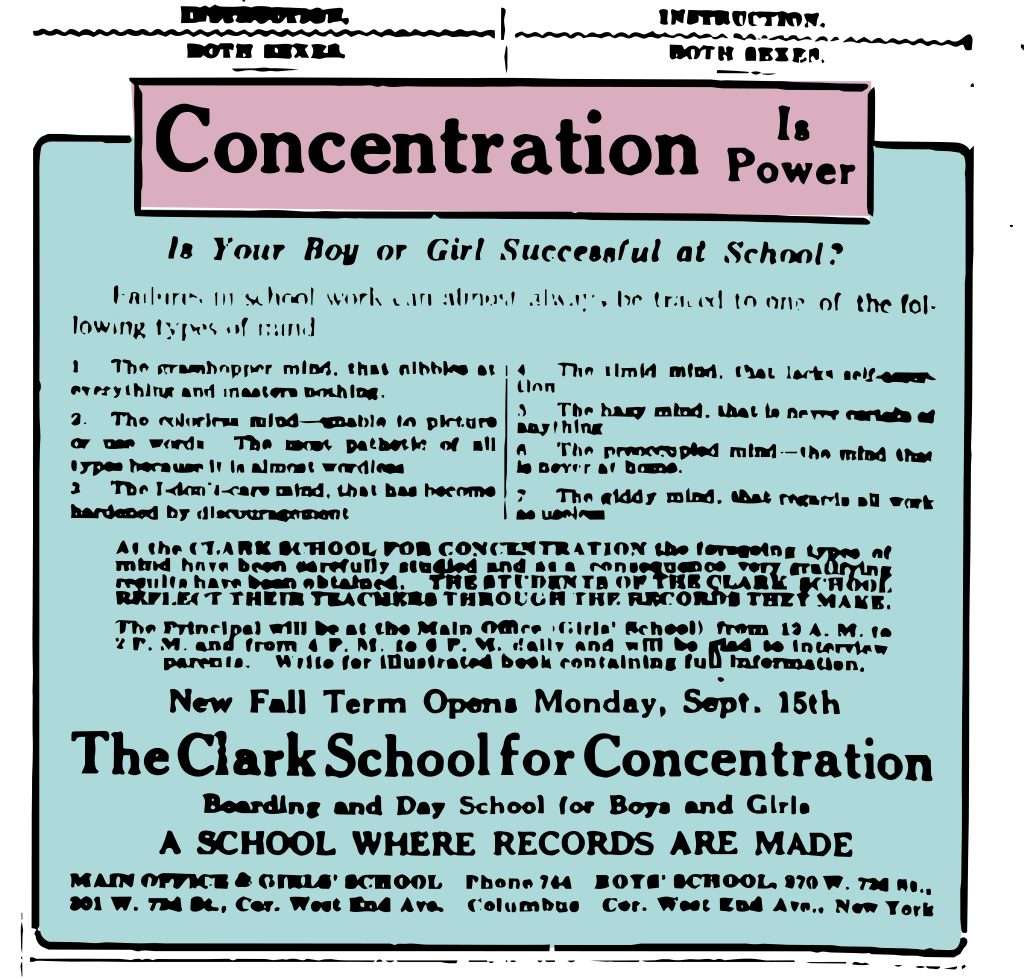
For years before the crash, Stevens had been developing a labor education curriculum for CWA’s Verizon workers — and growing frustrated. “You’d get people in the room and within five minutes they knew what you wanted them to think,” he said. “The rich got richer, and we couldn’t build power because of the polarization. We were stuck.” Union political education had functioned as internal marketing — leadership justifying its choices to members rather than building genuine worker consciousness.
The banking crisis solved the problem by force. Overnight, millions of workers had a direct, unmediated experience of the coming crisis he’d been warning the workers about in his classes. “It was the worst possible way to learn the meaning of solidarity,” Stevens said. “But we learned it.”
He encountered John Dewey around this time. Dewey had argued that democracy was not a set of institutions to be explained but a practice to be lived. “He was writing about classrooms,” Stevens said. “But he was describing organizing.” The Solidarity Caucus Stevens co-founded in a VFW hall basement in Stapleton began every meeting not with positions but with questions: What does a decent life cost in this city? Who has one, and who doesn’t, and why?
A deepfake holographic video appeared, showing billionaire mayors and governors lounging in a gated city club-spa, laughing about a coin dip that made them a windfall while wiping out pensions for what they called the "obsoletes." Whether the holo was fabricated or partially real didn't matter. It pointed to something that was real.
By 2038, IWP candidates held council seats in all five boroughs. Stevens won his own seat with 61 percent of the vote.
In parts of the city, the twenty-hour workweek is already in practice. On a Wednesday afternoon in April, Carlos Mendez, 41, a former warehouse logistics coordinator from Mott Haven, is in a painting class on the third floor of a community arts space on Willis Avenue — a schedule made possible by his new hours as a building systems technician.
“I used to not exist from Monday to Friday,” he said, without turning from the canvas. “I was just, like, a function. Now I’m living my own life. I feel like I woke up.”
Near the end of his Foley Square address, the crowd had grown quieter, the way crowds do when they sense a speaker approaching something they want said plainly.
"It was the worst possible way to learn the meaning of solidarity," Stevens said. "But we learned it."
“They built their compounds. They built their playgrounds. They built whole cities you couldn’t get into without a net worth statement. They thought we’d just clap along when they called it innovation. They called it disruption…”
He paused.
“But we’re going to call it a template. We do the hard work, and we’re going to share in the rewards from here on out.”
The City Council is expected to take up the 20-Hour Work Standards Act next month. A competing measure backed by the mayor’s office would establish a voluntary pilot program. The IWP has called it “a delay dressed up as a compromise.”