

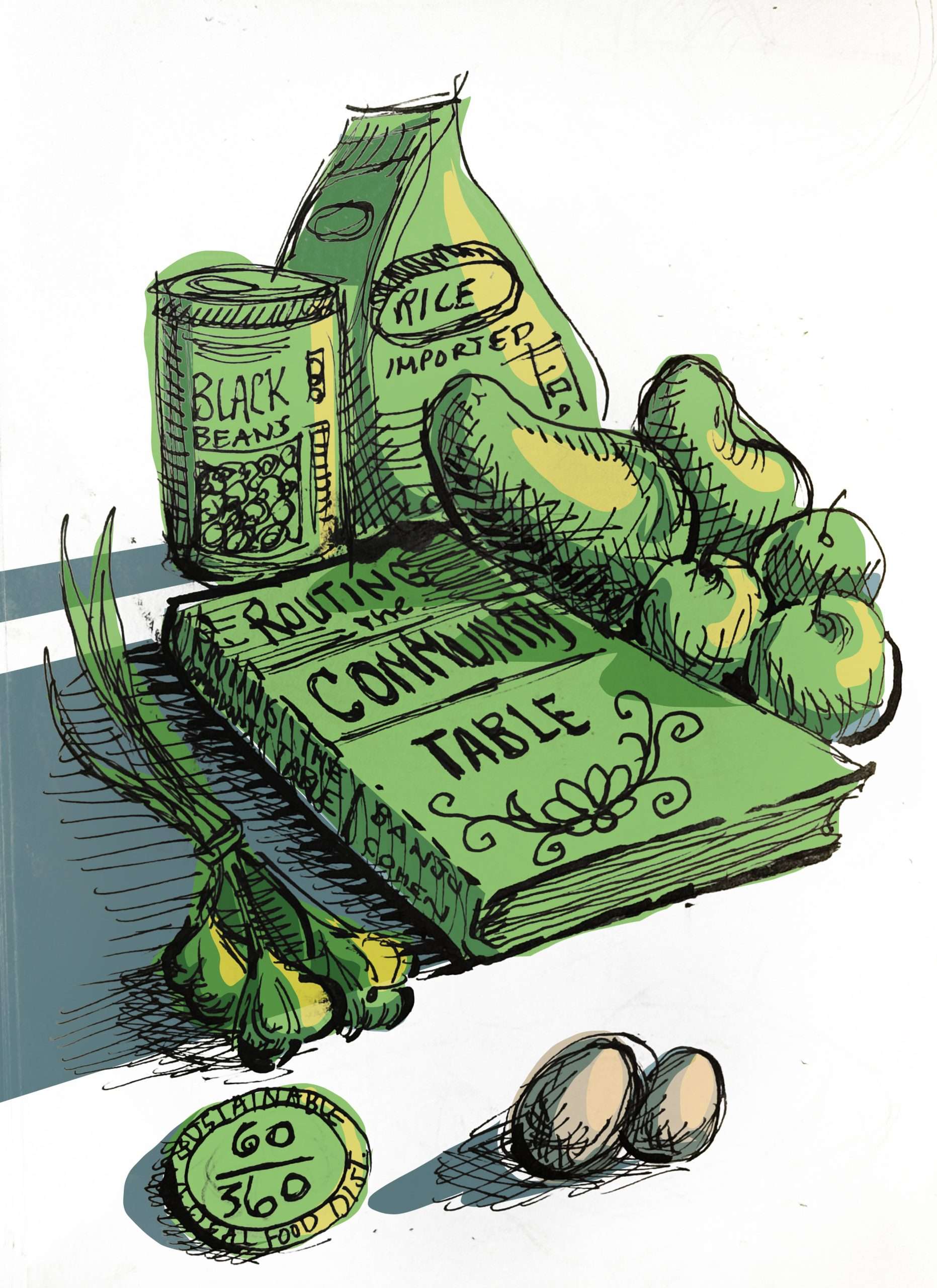
Risographed posters cover the wall of the Manhattan gathering space. Lively pinks, yellows, and greens layer map grid, the connecting arrows of a diagram, and the shapes of fruit, loaves of bread, and bees. “Routing the Community Table: Food Distribution in Philosophy and Iteration,” by Shiva Banju Cohen, is written in a hand-crafted typeface.
Banju Cohen sits underneath the posters. She has long curly dark hair with a few grey strands, wireframe glasses, brown skin and bright eyes; she wears a deep purple jumper while fielding questions. She’s speaking with a book group at the Woodbine Center in Manhattan — they’ve been given advance copies of Routing the Community Table from the initial 500 printed in Queens. Soon, digital copies will be available through the text-only servers of the Homespun local networks, under a community fair-use license.
“I want to dig deeper into your localism chapter,” says someone identifying themselves as Geon, a once-upon-a-time NYU adjunct and current member of the Crown Heights Tenant Gardeners. “I love how you connect local food production to the Right to the City framework — the expanded notion of citizenship that accounts for the full spectrum of existence here, which means the right to a portion of the high-quality food grown around us. And your critique of luxury cuisine is sharp.”
Geon leans forward. “But I also want to bring into the room the question about longer distance transport. I’m thinking about your discussion of bananas from the Caribbean that arrived as luxury items and later became staples, and your nuanced call for diet narrowing toward greater localism. Because here’s my question: this region isn’t exactly a breadbasket, especially after the long winters and unseasonal frosts of the last decade. A hundred years ago, most dairy and many vegetables were still produced close to the city. People changed their diets with the seasons. We can’t go back in time, but we do need a balance. The Crown Heights Tenant Gardeners have been working on this, and we’ve developed the 60/360 framework: sixty percent produced within three hundred sixty miles. We believe that percentage is optimized for cost — it lets us balance local food with the cheaper prices of staples like rice and dried legumes that allow for more equitable distribution across the city. But we’re getting a lot of pushback from the OnlyLocallyGrowns about sourcing only sixty percent locally. We feel we need to get beyond purity politics to continue scaling up the networks. What are your thoughts?”
Banju Cohen nods. She has spent fifteen years with the Flatbush Food Autonomy Collective, and she speaks with the confidence of someone whose knowledge was built outside the walls of an ivory tower.
“Henri Lefebvre, when he wrote about the Right to the City in 1968, wasn’t describing a consumer right,” she begins. “He was describing the right to participate in shaping urban life itself — its rhythms, its textures, its daily reproduction. Food is a relationship between people and land and labor—it’s not a product.” She adjusts her wireframes. “The OnlyLocallyGrowns are voicing an ethical impulse I respect — but ethics that can’t scale are often aesthetics more than politics. I’ve been following your 60/360 framework and it’s asking: how do we build something new that can actually feed a city? So yes, we need both philosophy and iteration. And we need scale.”
A hand goes up from the back — a man in his fifties who teaches political theory at Yale. He wants to know about the ontological implications of food sovereignty for citizenship theory. Banju Cohen listens, then gently steers back. “What you’re describing is a real tension in the literature,” she says. “But we need to unite the book worms and the earth worms for the meaning to meet the moment.” Fingers around the room snap.
"Ethics that can't scale are often aesthetics more than politics."
The New Literacy Movement
Many current and former academics are in attendance — professors from CUNY, from what remains of the NYU humanities program, Yale, Columbia, and Fordham. Some still have tenure, and the humanities haven’t been entirely defunded so much as steadily winnowed. But scholars come to spaces like Woodbine the way their predecessors once came to the Brecht Forum or 16 Beaver — because the democratic energy in the room is something their institutions can no longer provide. What they’re coming to participate in has acquired a name: the New Literacy Movement.
The movement emerged from three overlapping crises: the chaos of AI-generated content, which made it increasingly difficult to distinguish knowledge from noise; the collapse of public trust in institutions that had once organized information; and the rise of the mutual aid economy, which required people to govern themselves and make complex decisions collectively. You cannot run a food distribution network, negotiate a community land trust, or coordinate a flood response across five boroughs without a shared capacity to analyze, argue, and decide. Woodbine’s co-founder Matt Peterson had been warning about this for years, connecting the erosion of serious reading to what the French theorist Régis Debray called mediological decline — the historical shift from word to image to video in political life, and the corresponding loss in depth of collective thought. “The most important political training,” he has said, “is the ability to read carefully, think together, and articulate what you actually believe — not what an algorithm has decided you want to hear.”
In practice, the movement is far more unglamorous than its name suggests. It has meant reading groups — sometimes eight people, sometimes thirty — working through a text together. Woodbine’s reading group now has four hundred members; about thirty show up regularly in person.
Banju Cohen came to her book this way. Routing the Community Table was not produced by a university press. It was developed over five years through the Flatbush collective’s reading groups, kitchen workshops, and distribution experiments, with research support from a small grant administered through a network of autonomous spaces. She is part of a generation of academics for whom the dream of an institutional career is genuinely over — no more middle class existence as a humanities professor — but who invested early in their affinity networks and found, in them, continuity of purpose.
"You cannot run a food distribution network, negotiate a community land trust, or coordinate a flood response across five boroughs without a shared capacity to analyze, argue, and decide. That's the kind of literacy the movement is about."
Woodbine itself traces a longer lineage. Matt grew up in the Bronx, was educated by Jesuits, and spent his twenties in the downtown New York milieu of punk venues, radical film screenings, and study groups. When the financial crisis hit in 2008, he stopped waiting for institutions to give him permission to learn and began curating his own education alongside others who felt the same. What followed was a sequence: Red Channels, the nomadic film screening collective. Then Occupy. Then Hurricane Sandy in 2012, which showed that collective power dispersed across five boroughs was no power at all — and catalyzed the decision to localize, to move to the same neighborhood, to share keys and dinner tables. Woodbine opened in Ridgewood, Queens in 2014. Through the pandemic, the first Trump years, the Great Flood, and the decade of recovery that followed, it built a community garden, a CSA, a bookstore, a food pantry, a seed library. In 2025 it handed the Ridgewood space to the volunteers who had built it — now Ridgewood Commons — and moved to Manhattan, to something less social center, more think tank: a node connecting similar spaces across the country, hosting the theory sessions that help the mutual aid ecosystem understand itself and act more strategically.
This is part of a broader shift toward what has come to be called the Real Sharing Economy — not the one that was promised by the internet in the 2010s and ultimately captured by a handful of corporations. Share your extra space, the early Airbnb advertisements said, with photographs of warm apartments and smiling strangers. Drive in your spare time. The companies that emerged from these invitations extracted data, suppressed labor rights, and redirected value to billionaires with extraordinary efficiency.
After the Great Flood of 2032 — when the storm surge overwhelmed Lower Manhattan’s new sea barriers, flooded the A/C subway tunnels from Howard Beach to Rockaway, and left hundreds of thousands of outer-borough residents without income for weeks — the mutual aid networks that had been quietly building for two decades — the ones that traced their lineage through Occupy Sandy, through the COVID pantries, through spaces like Woodbine — were suddenly operating at a scale they had never anticipated.
Today, turn down any street in a real New York neighborhood and you are likely to pass a food pantry. Many neighborhoods have social centers where people gather — to hang out, to dance, to organize, to simply be in a room together. After the extreme summers and brutal winters of the late 2030s, many of these spaces also function as cooling rooms in July and warming rooms in February — the same function the Ice Box cooling stations served at the West Indian Day Parade, scaled down and made permanent.
Woodbine has always understood itself as part of a longer sequence — the secular American version of what a church used to be.
The Party
"The developer needed community amenity space to get permits. The community took the offer and opened a small bar run on the honor system, and a makeshift stage where a DJ is setting up."
After the book launch, the conversation continues informally on the sidewalk, then migrates, as these things do, toward Queens.
The celebration for Routing the Community Table is held that evening at the Nostrand Commons in Ridgewood — a social center in the ground-floor retail space of a forty-story luxury tower that went up on Forest Avenue during the post-flood reconstruction. The developer needed community amenity space to get permits. The community took the offer and made it theirs: mismatched furniture, a small bar run on the honor system, a makeshift stage in the corner where a DJ is setting up. It is one of the buildings that came out of the post-flood rezoning that the Mott Haven Community Land Trust helped push through — a deal that extracted public amenities from developers who otherwise would have built and left.
The luxury apartments above are mostly occupied. Some of their residents occasionally drift downstairs, curious or friendly. Most don’t. The tower rises above the party. The city is not a utopia. The same land pressures that made Woodbine necessary in the first place have not been abolished; they have been partially, stubbornly, fought to a partial draw. There are more social centers and fewer luxury towers than there might otherwise have been.
Banju Cohen is dancing near the stage. Geon is arguing about food miles with someone near the bar. Matt is in a corner, talking to a young woman from a new collective in Mott Haven — not far from where the Land Party swept the last borough elections — explaining something, listening more than he speaks. The music is loud. Outside the windows, the lights of a transformed and untransformed city extend in every direction.