
It’s nine AM and twenty-five thirteen-year-olds walk south down 5th Avenue, turning uphill toward Sunset Park. They are blindfolded. Each has a hand on a rope controlled by two teachers, keeping them from wandering into traffic. Occasionally, they stop, grab the boxy film cameras around their necks, point them in a random direction, and click the shutter. They have no idea what they’re shooting. That’s the point.
Such sights have become common across all five boroughs — kids navigating by sound and touch, students singing on traffic medians timed to the whoosh of the city’s networked autonomous traffic, dozens of kids pressing paper against buildings, trees, manhole covers, capturing the city’s texture in graphite. All of it is FULLSL8, the city’s newest answer to what educators call the Blank Slate epidemic.
Blank Slate
“Drawing something on blank paper became, at some point, just not something they could do,” says Ms. Kelly, a middle school art teacher in Brooklyn, and one of FULLSL8’s co-founders. “The brainstorming stage was always the hardest thing to teach. But there was a time when I could get them there — those were the magic moments I was always chasing. Then that started to close down.”
The problem wasn’t recognized as an epidemic until the floods of the early 2030s knocked out the power grid. City emergency workers began encountering something that didn’t fit any existing category.
“We’d find young people just sitting in immobile groups, heads down, as their batteries had died,” says Deputy Commissioner Andrés Villanueva of the Office of Emergency Management. “They couldn’t consult their devices, so they couldn’t answer a single question. We ended up holding hundreds of them at the old 72nd Precinct — just waiting for the power to come back on. It was pretty sad, actually.”
Each has a hand on a rope controlled by two teachers, keeping them from wandering into traffic. Occasionally, they stop, grab the boxy film cameras around their necks, point them in a random direction, and click the shutter. They have no idea what they're shooting.
The conditions had been building for years — through devices, games, embedded school platforms, and eventually the integrated chip, a subcutaneous AI prosthetic adopted by roughly a third of NYC public school students within three years of its 2031 release. By 2033, the DOE had a name for it: Creative Agency Deficit Syndrome. Teachers called it the Blank Slate.
“You can’t have art without intention,” Ms. Kelly says. “And if there’s no intention, there’s nothing. I’d have students in front of a blank paper for a full hour, and nothing would come. They genuinely felt there was nothing they could say or express by themselves.”
Zero Gravity
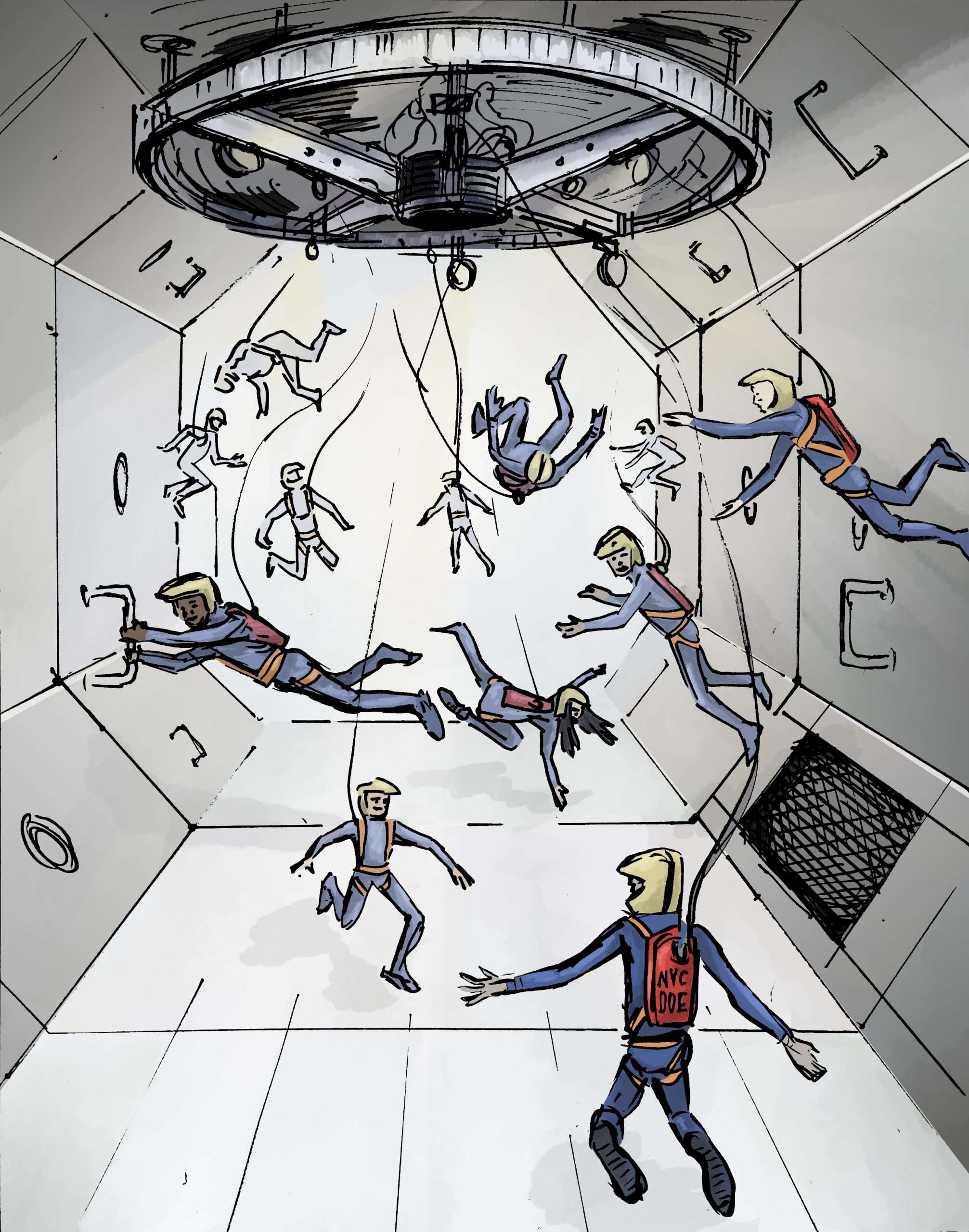
Ms. Kelly is floating. So are her students.
The FULLSL8 Zero Gravity Simulation Tank sits in a smooth white sphere adjacent to the American Museum of Natural History. The students are harnessed into motorized cables that perfectly counterbalance their weight. It is the most sought-after field trip destination in the five boroughs. Schools apply eight months in advance.
Her photograph shows ghostly streaks of passing delivery vehicles, a lamppost cutting through the frame, and in the lower left corner, her own hand, slightly out of focus, reaching out.
“We want you to be quite a bit disoriented,” Ms. Kelly says, drifting toward the center. “You will create from what you find.”
A sensor pulses. A seventh grader named Tomás is pressed against the far wall, eyes wide. His printer spits out a slip the size of a fortune cookie fortune: You don’t have to move. Just feel the wall against your back. He reads it. Looks up to see her near, smiling. He nods once. With thirty students, it is not unlike conducting an orchestra.
Back in the Room
It is the end of the semester. The classroom started the year as a clean white space — intentionally blank. Now the long wall is covered in rubbings: the diamond grid of a manhole cover, the grain of a London plane tree, a building cornerstone reading 1924. Above them, photographs — some crisp, some motion-blurred — from the blindfold walk.
One is Amara’s. She spent most of the semester insisting she was bad at art. Her photograph shows ghostly streaks of passing delivery vehicles, a lamppost cutting through the frame, and in the lower left corner, her own hand, slightly out of focus, reaching out. She is mesmerized by it.
We'd find young people just sitting in immobile groups, heads down, as their batteries had died. They couldn't consult their devices, so they couldn't answer a single question. We ended up holding hundreds of them at the old 72nd Precinct — just waiting for the power to come back on.
In the corner, a science teacher explains hypothesis formation to students beginning the semester’s final project. They will design their own studies, collect their own data, and make something from it that no algorithm has proposed.
What will they make?
They’ll be the ones to decide that. That’s the point.
“The goal is to help them have an idea,” says Ms. Kelly. “To help them become people who could feel something and then decide what to do with it. Who didn’t need to transfer their agency to a computer?” She pauses. “That’s what art is.”