



The day before New Yorkers voted on Initiative 7, the sky above Midtown filled with light bulbs.
They were six feet in diameter, drone powered, drifting above the heads of pedestrians as they moved through the city. Each bulb rotated slowly, bearing the message in block letters: “THE SMART VOTE IS YES.” They were met with giggles and the snapping of pictures. It was quite a sight. The whole production cost, by later estimates, somewhere around sixty million dollars — pocket change for those pushing Initiative 7. But the next day, unexpectedly, Initiative 7 failed.
The ballot initiative had proposed a massive allocation of the city’s energy budget for AI. This, at a time when almost all of the gas infrastructure is gone — a transition that was necessary if brutal. The city runs on electricity now, and the system is strained by demand. Last summer, during an oppressive heat lasting eleven days, four hundred people died in apartments that couldn’t afford to run their cooling systems. And yet, Amazon had been building a campaign to redirect seventy percent of the city’s municipal energy allocation to yet more AI data infrastructure, for the sake of national security. The ballot language called it “The only smart and sane future for NYC.”
The fact that the electricity was needed for transit subsidies, for cooling cost relief, and for the hospital grid was not mentioned in any campaign materials. The New York Power Authority, still managing the fallout from Tesla’s undersea siphoning scandal, had warned the city repeatedly that the grid could not absorb another major reallocation. Amazon was confident that the initiative would pass anyway.
Since the late 2020s, AI-driven misinformation campaigns have made ballot initiatives reliable terrain for corporate capture. Technical enough to confuse many voters, they are also local enough to fly below national fact-checking infrastructure. And they are binary — yes or no — which makes them susceptible to a well-funded information environment that makes the wrong answer feel like common sense. Water privatization measures, transit authority transfers, broadband restructuring deals: initiative after initiative has sailed through on the strength of viral videos, algorithmic targeting, and an information environment that was, as one leaked campaign document put it, “optimally permissive.”
Initiative 7 was supposed to be the same. It started polling at fifty-four percent in favor. Then a movement building behind the scenes for nearly two decades became visible.
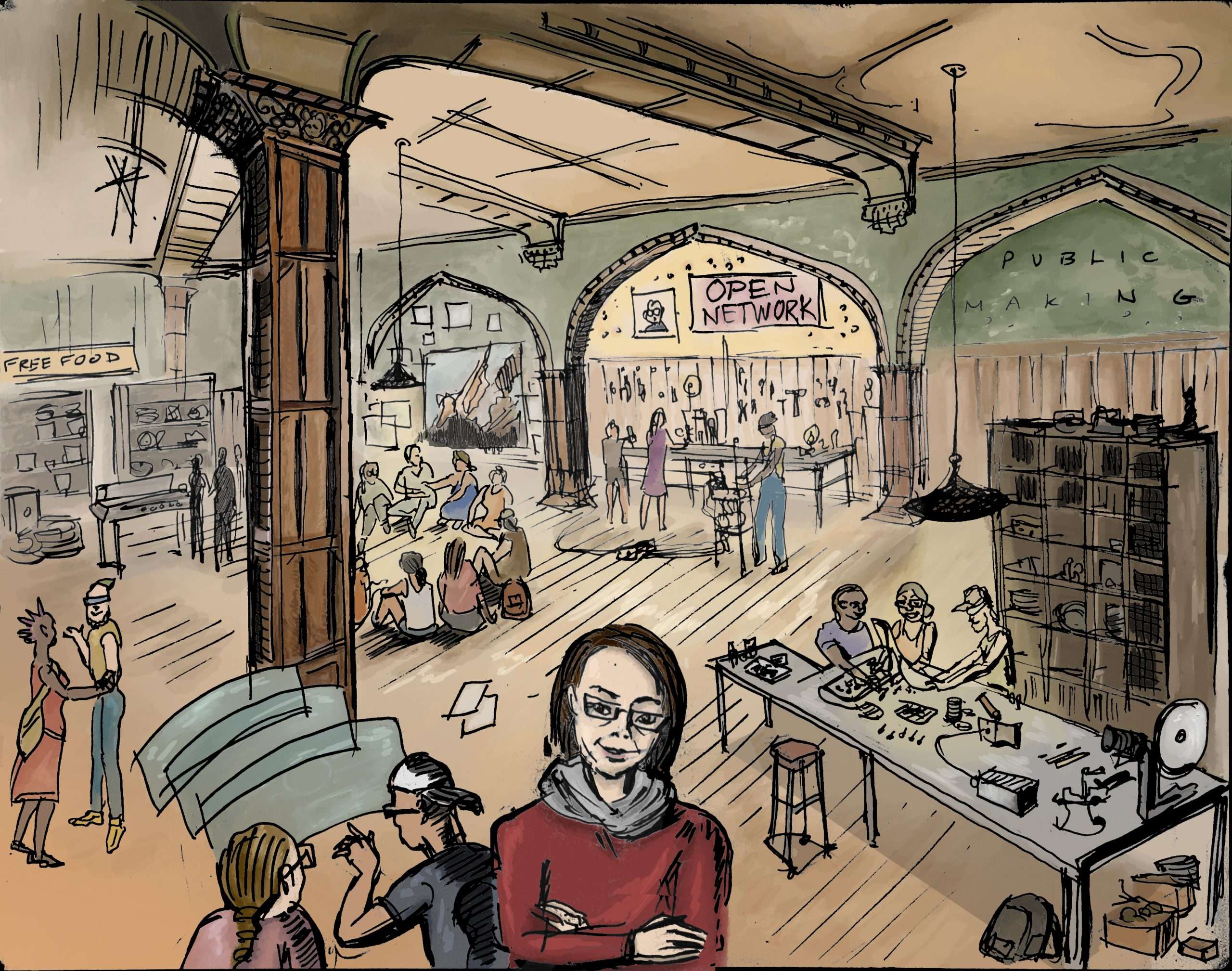
On a Wednesday morning two weeks after the vote, I take the 1 train to 116th Street and walk to Teachers College. The ground floor, where the main lobby used to funnel visitors toward administrative offices, has been reconfigured into something that feels like a cross between a public library and an electronics repair shop. This is the Distributed Network Hub — one of eleven spaces Teachers College now operates across the five boroughs under a partnership with the city. The public resource network is a post-Mamdani municipal initiative that began with the public food markets, and has extended the library system’s logic into civic tech, community health, and, increasingly, network infrastructure.
The Hub is free and open six days a week. People come to learn and to build. The equipment — circuit boards, soldering stations, signal testing rigs — is available to anyone who’s completed a basic orientation. On the day I visit, thirty-odd people are working in the space. Just a few are affiliated with the university.
Ioana Literat, the Hub’s program director, is near the windows talking energetically with students about a network topology diagram on a whiteboard. She grew up in Romania, came to the U.S. for graduate school, and has spent two decades at Teachers College pushing against what she calls “deficit thinking” — the institutional habit of treating young people’s relationship to technology as a problem to manage rather than a capacity to develop. She waves me over.
“You want to know about the vote,” she says, “you’ve come to the right place. But we need to start a little earlier. Like 2026.”
"When Musk bought Twitter, we knew right away what it meant. Your organizing labor could just disappear overnight, because someone essentially bought the building you were living in."
In 2026, Elon Musk had owned Twitter for four years, transforming a platform relevant to many journalists, activists, and information seekers into a cesspool of reactionary politics and fabrication. The lesson was clear: one billionaire’s whim could restructure the information environment for millions overnight, deleting years of organizing.
“When Musk bought Twitter, we knew right away what it meant,” Literat says. “Your organizing labor could just disappear overnight — accounts deleted. Not because you’d done anything wrong. Because someone bought the building you were living in.” Young people in the 2020s were building their civic lives on rented land.
“These were platforms they didn’t own, couldn’t govern, and could lose without notice,” says Literat. And yet, critique of this power wasn’t enough.
“Pessimism was popular at the time, but pessimism about technology is a privilege,” she says, borrowing a line from scholar Payal Arora, who writes about tech communities in the Global South. “Communities in India, in Pakistan, across Africa where resources are scarce, couldn’t afford to be dystopian. They had to build with what they had. Eventually, we arrived there too.”
The building period took decades.
It began during the Black Lives Matter uprisings. Activists and community organizations started running private servers to maintain communications outside platforms willing to cooperate with law enforcement. When ICE operations rocked American cities under the second Trump administration, the vulnerability presented by corporate platforms became immediate and concrete. Some activists brought server infrastructure to Mexico, the Netherlands, Spain, and Canada.
And then, as the housing crisis forced New Yorkers into new communal living modes, it became easier to organize autonomous networks in buildings. DIY mesh networks appeared in Bronx apartment buildings, in Sunset Park community centers, in Southeast Queens churches. The Stages of Life building in Williamsburg — covered in our housing issue — was an early adopter, its mixed-generation residents among the first to wire a node into their building’s governance structure. “When all the tech lords stood behind Trump,” a network organizer will tell me later, in Forest Hills, “we got the message.”
By the late 2030s, somewhere between sixty and seventy percent of people under thirty were using these distributed networks as their primary information environment. Instagram is still everywhere, but organizing, community building, and trusted communication takes place elsewhere.
“Meet one of the core organizers behind defeating Initiative 7,” Literat says proudly, gesturing to Camille Torres, twenty-seven, from Mott Haven. Torres is finishing a certificate in civic network design while managing her local community network. She also runs a training program for new organizers in the northwest Bronx — not far from where the Mott Haven Community Land Trust has spent the last decade building what it calls civic infrastructure from the ground up, block by block. She does not stop tapping on her flexible screen as she talks to me.
“It should be a simple thing, really,” she says. “People just need to understand what they are actually voting on. But it’s not simple.”
"A full day of community networking — news, governance, event coordination, everything — takes about the same bandwidth as one ten-second video stream did fifteen years ago."
Her grandfather died in 2033. A retired MTA worker, he had spent his sixties on Facebook following local politics — until an algorithm migrated his information diet, over roughly two years, toward a constellation of conspiracy content that grew from the wreckage of the Epstein revelations and the Trump years. He became consumed by it, withdrawn from the family, unreachable. He died estranged from nearly everyone who had known him.
“Fact checking can’t counter the power of the platform,” Torres says, looking up. “You need to build up person to person connections and create a community that trusts each other. We are building platforms, but trust is the infrastructure. Without the trust, you have nothing.”
The maker corner is dense with storage containers, sorted circuit boards, wire spools, and soldering stations trailing thin smoke on no-frills tables. Above one workstation hangs a poster of a man smiling broadly.
“That’s Bunker Roy,” Literat explains. “He founded the Barefoot College in India — trained rural women to become solar engineers.”
The group working in the maker corner moves with a particular deliberateness. Dressed in natural-fiber minimalism, the aesthetic signature of the low-power networking community, they seem self-possessed. They speak carefully, make sustained eye contact, and carry the slightly evangelical quality of people who feel they are living by a principle that many more people will one day understand.
The principle: less energy is more.
The distributed networks are low energy. They run almost entirely on text — no video, no autoplay, no recommendation feeds. The hardware is designed to be locally repairable. The data flows are, by any legacy standard, almost comically lean. And it has to be cheap. “A full day of community networking — news, governance, event coordination, everything — takes about the same bandwidth as one ten-second video stream did fifteen years ago,” says Dario, twenty-three, soldering something small and intricate without looking up. He says it with the pride of someone who has been waiting to say it. “The hardware for a node that networks an entire neighborhood costs about the same as a bicycle.”
Someone across the table doesn’t look up. “Yeah, but the installation is another matter.”
“The wire is expensive,” another person says, still not looking up.
"Yes," Literat says. "And we'll have to build something better than what we have now. That's how it works."
“Except we don’t buy it. Half this network runs on cable pulled from buildings that were rewired in the thirties. The city has a reclamation program. We get first call.”
Nearby, another debate has been running for some time. That argument is about security protocols, and several people tell me with varying resignation that it is a recurring one. Low-power networking presents real cryptographic challenges — the signal constraints that make the networks affordable also limit robust encryption. The security faction advocates community-managed rotating cipher keys. The open-network faction says that undermines the civic mission.
“Paranoid?” says Sofia, a security advocate who has clearly been called this before. “These networks were built to keep communications alive during the BLM uprisings. They were expanded when ICE was going door to door and tech companies were cooperating with the federal government. The core has always been security.”
Someone across the table groans. “This same conversation,” they say, “every single week.”
Before I leave, Literat takes me back to her office, which opens onto the Hub and currently contains three students running a training session in the corner. She seems to find this normal. I ask what she made of the vote. “I have argued for most of my career that young people are not passive victims of technology,” Literat says. “That they are skilled, capable of building and not just consuming. And I’ve argued — this part people liked less — that being critical isn’t enough. That pessimism is a posture. That you have to actually build the alternative.”
Priya, one of the students in the office, nods. “There’s a relationship to what comes through this network that’s different from anything I’ve felt online before. It feels like ours. There are no billionaires behind it. No algorithm trying to figure out what will keep me scrolling. The information that comes through — we want it to be good, so we make it good.”
“Don’t get comfortable,” says another student. “The AI is mapping our networks right now. Next time they run a campaign like Initiative 7, the messaging will be designed for us. They’ll know exactly how to win.” The room is quiet for a moment. “Yes,” Literat says. “And we’ll have to build something better than what we have now. That’s how it works.” She glances out at the Hub, where someone is still at a soldering station, working on something small.
Somewhere across the five boroughs, on rooftops from Mott Haven to Forest Hills, the same quiet work continues — a few kilobytes at a time.