

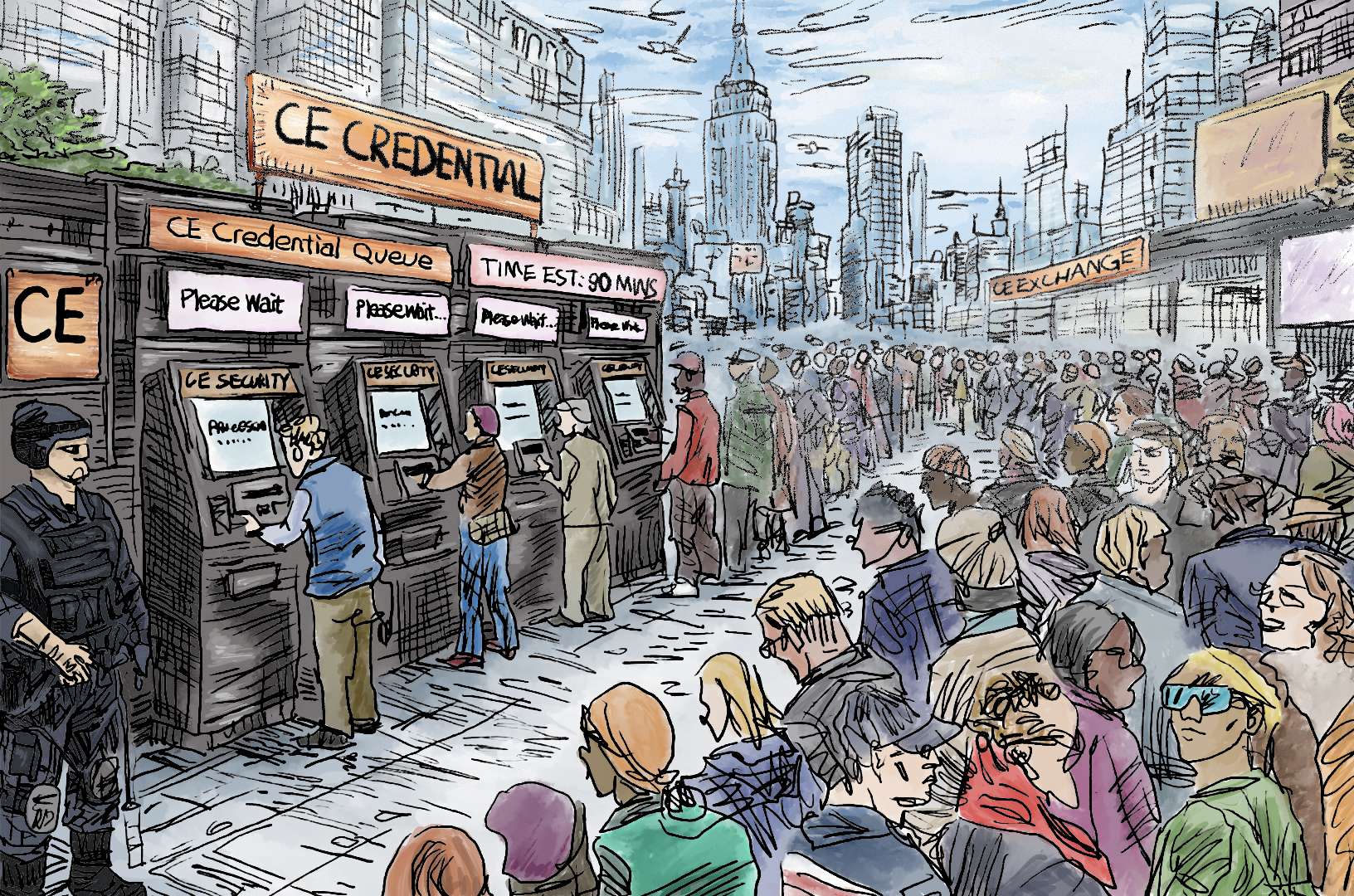
Riawv B. is 48 years old, and for the past fourteen months, a city-run computer system has been unable to confirm that he exists.
His credential kiosk reads Not Displayable. His building access card stopped updating last spring. The payroll system at the university where he teaches — where he has taught, on and off, for eleven years — briefly lost his record entirely. No explanation was offered. He is not alone. As of this February, an estimated 10,200 accounts in the city’s Contribution Equity system carry the same flag. The majority are artists, adjunct instructors, and cultural workers.
CE — Contribution Equity — arrived five years ago as an answer to a problem everyone in the city’s cultural economy understood, and no one had managed to solve. Built on a blockchain Learning and Employment Record, it promised that exhibitions, teaching appointments, collaborative projects, and published criticism could be uploaded, timestamped, and translated into tokens that offset tuition debt and supplemented housing costs. The subway advertisements were everywhere: Every Contribution Counts. For a generation of cultural workers who had spent two decades watching their imagery, writing, and creative output scraped into AI systems without compensation or credit, the ad landed.
“Artists had been fighting the AI labor theft question for twenty years without a legal mechanism that worked,” says Dr. Fatima Osei, an education economist who consulted on the system’s early design. “CE spoke the same language. It said: ” Your work counts. People wanted to believe it.”

Riawv B. wanted to believe it. He uploaded his entire archive — twenty-one years of exhibitions, teaching appointments, studio visits, reviews — watching each entry resolve into a confirmed node. I’m not a huge believer in this sort of thing, he remembers thinking. But what did I have to lose?
The technology had produced, with considerable precision, an exact description of the problem it had promised to solve.
He would spend the next year finding out. CE verified his history without difficulty. It then classified his income prospects as highly inconsistent and his account as elevated-risk. The technology had produced, with considerable precision, an exact description of the problem it had promised to solve.
The deeper contradiction arrived with the city’s UBI expansion in the early 2040s. As automation displaced workers across sectors, the city issued stipends to those in transition — including a substantial portion of the creative workforce. The CE risk algorithm read those stipends not as a bridge, but as a confession. A person receiving a city stipend to make art was, in the algorithm’s judgment, a person who was not working. Two systems designed to help have combined to push artists further outside the economy than before.
Last May, adjunct instructors marched against the incorporation of CE scores into university hiring decisions. Riawv B. attended. He stood near the edge of the crowd, took a holo, and posted it to the flow. Within days, his access card stopped updating. Within two weeks, 847 other accounts showed the same flag. By July, the number exceeded six thousand — drawn not only from marchers but from people who had reposted coverage, or simply written critically about CE in public forums.
The explanation arrived in a leaked internal memo: automatic behavioral risk escalation. Attending a protest qualified. So did posting about one. The credential system designed to recognize invisible labor had built, somewhere in its architecture, a mechanism for making troublesome workers invisible.
The credential system designed to recognize invisible labor had built, somewhere in its architecture, a mechanism for making troublesome workers invisible.
But the blocked accounts had done something unintended: they produced a list. Six thousand flagged accounts, each belonging to someone who now knew they shared a credential status, a grievance, and a paper trail. The atomization that had kept cultural workers isolated for decades — each managing precarity alone, in their own studio, on their own adjunct contract — was briefly, accidentally reversed by the bureaucracy trying to suppress them. They formed the Unverifiable Workers Coalition in October. By January, they had nine thousand members.
Their demand was precise and considerably more threatening than abolition: restructure the token’s risk model to recognize cultural labor on its own terms, and formally link CE to the long-stalled AI Creative Labor Compensation framework. CE, it turned out, had accidentally built the infrastructure the AI labor fight had always lacked — a permanent, verifiable, blockchain ledger of creative work that could not be quietly altered.
“CE was trying to count labor that the economy ignored,” says Osei. “The Unverifiable Workers flipped the question. They said: You’ve already counted it. Now make the machines pay for what they took.”
"I uploaded everything," he says. "I thought I was asking for credit — asking to finally enter the economy. It turns out I may have been building evidence."
Riawv B.’s account still reads Not Displayable. In his studio, surrounded by twenty-two years of making things in this city, he has been thinking differently about what the ledger contains.
“I uploaded everything,” he says. “I thought I was asking for credit — asking to finally enter the economy. It turns out I may have been building evidence.”
The City Council vote is scheduled for April. Across the city, nine thousand members of the Unverifiable Workers Coalition are waiting — flagged, blocked, and in possession, for the first time in twenty years of losing, of exactly the kind of documentation that tends to make large institutions very nervous indeed.