




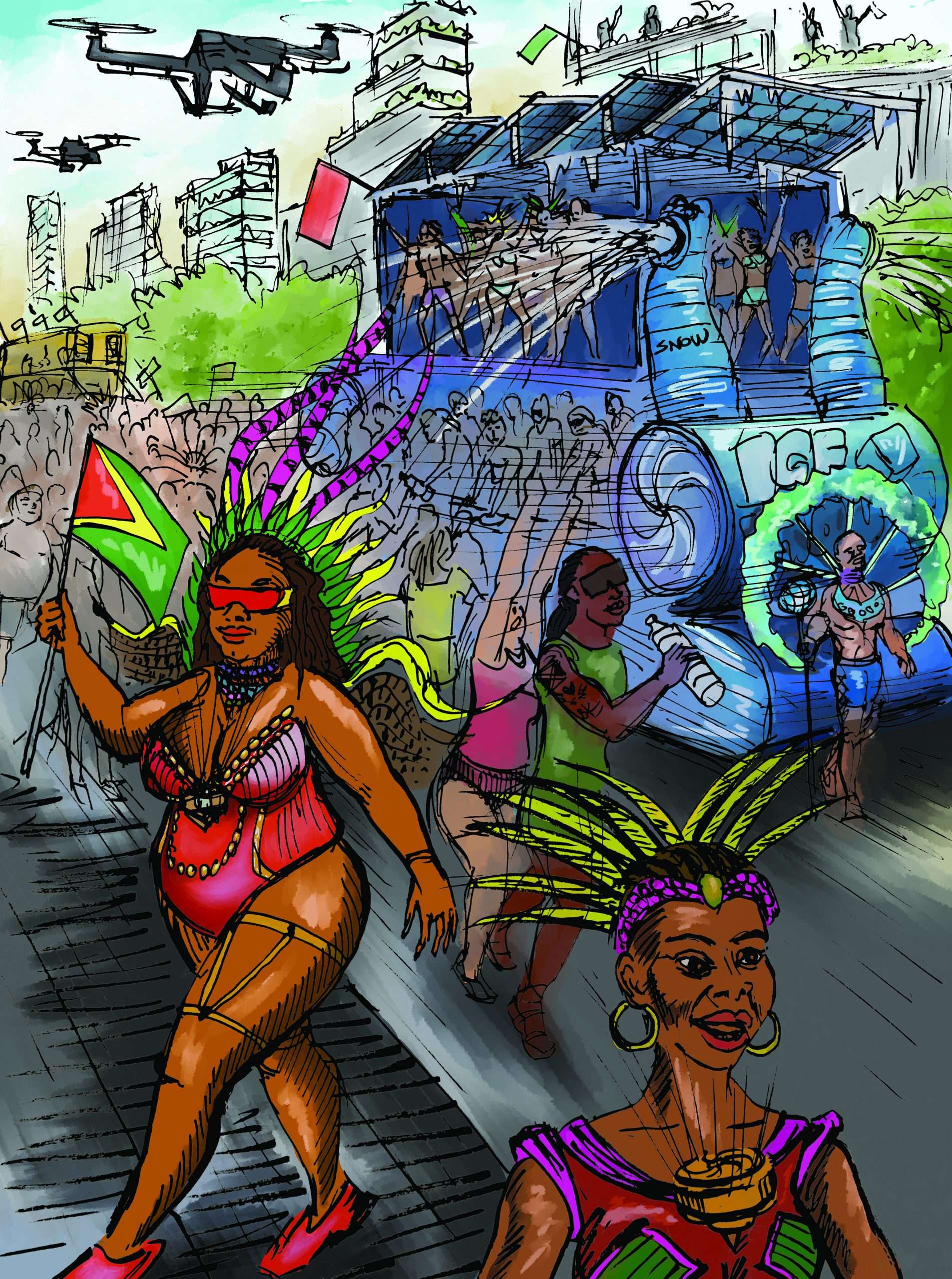
Colorful feathers bounced to the rhythms of Reggaeton, Soca, dancehall, and Neotrop, as the revelers made their way down Eastern Parkway. Jerk chicken smoke was heavy in the air, and bodies glistened with sweat as the sun beat down, heating the city to 95 degrees with nearly 90% humidity that early September day. Feathers quivered to their pulses of mini-fans, and cooling belly-bands and back plates were integrated into costumes— ultra-cooling min-tops and thongs.
Despite the withering heat, spirits were high until two NYPD Prowler drones collided over the parade. They spun wildly and tumbled down into the crowd, cutting two dancers who were eventually carried away on stretchers with severe but non-life-threatening injuries.
“Folks were passing out from the heat,” said Shani Charles, from Flatbush. “We’re told the drones carry all the necessary emergency equipment to save lives, and that’s why they monitor gatherings. But no, they buzz around like angry bees and sting people.” Ms. Charles was referring not just to the accident, but to the incident shortly after the collision in which drones identified four dancers as security threats and harassed them out of the area with localized sound weapons. “Could have been bad credit scores,” Charles considers. “Could have been nothing at all, you just have no way of knowing.”
The collision sucked much energy out of the parade until the ICE BOX float made it to the Brooklyn Museum shortly after the drone disturbance. The ICE BOX is a popular and highly refreshing presence at the parade, literally showering snow into the dancers. ICE BOX DJ XXFI was on the mic, playing local hits and speaking to the crowds. Fear and anger turned to laughter as he cracked jokes at the expense of the flying robots.
Besides the repurposed snowmakers from an upstate resort that blow through tubes resembling elephant trunks, the ICE BOX float sports 4 enormous solar-powered fans that blow air over beds of ice.
ICE BOX represents the original group of Brooklynites—Caribbean Americans from the Flatbush neighborhood, where the cooling network began. Besides the repurposed snowmakers from an upstate resort that blow through tubes resembling elephant trunks, the ICE BOX float sports 4 enormous solar-powered fans that blow air over beds of ice. They covered a wide swatch of the parade, and crew members were distributing cold water and ice packets as well as scanning the crowd for signs of heat exhaustion.
ICE BOX represents a huge network of mutual aid Urban Cooling Rooms. Amid the tumult of the parade, we spotted Kamari Dixon, a long-time ICE BOX organizer.
“This summer was again the hottest on record,” Dixon says. “No surprise there. We’ve added twenty new urban cooling rooms. These are private rooms that folks have made available to anyone who needs a quick cool-off. These are not just the micro-communes opening rooms; these are normal New Yorkers who might have personally suffered heat-related illnesses and are starting to see that private property needs to be understood a little differently as the planet warms, because they might need a cooling room if they are across the city and they overheat. Especially after the new restaurant policy.”
Could have been bad credit scores. Could have been nothing at all, you just have no way of knowing.
Dixon refers to the no-loitering bill, which was passed last year by the city hall and makes it easier to remove customers who spend too much time at restaurants and other service-oriented businesses, most often to get out of the extreme heat.

“We would of course want to open our doors to all New Yorkers in need, but it’s not realistic to ask restaurants to just shift into the unpaid emergency service industry,” says Rae Ellberg-Santos, of the NYC Hospitality Alliance. “Restaurants have been forced to close as people clog up tables and free AC for months during the year. It’s the city’s job to provide this service.”
The city reports that a complete system of Resilience Hubs on city-owned properties will be up and running in the next 3-5 years. We asked Dixon whether the informal Cooling Rooms would be disbanded at that time. They chuckle. “That sounds nice, but if we lose the autonomous rooms, where are we going to organize the rent strikes?”
That sounds nice, but if we lose the autonomous rooms, where are we going to organize the rent strikes?
“Is Cooling a Right?” Shouts DJ XXFI as the ICE BOX headed for Grand Army Plaza. “Let me hear you!”
“Cooling is a Human Right!” the revelers chant back.