


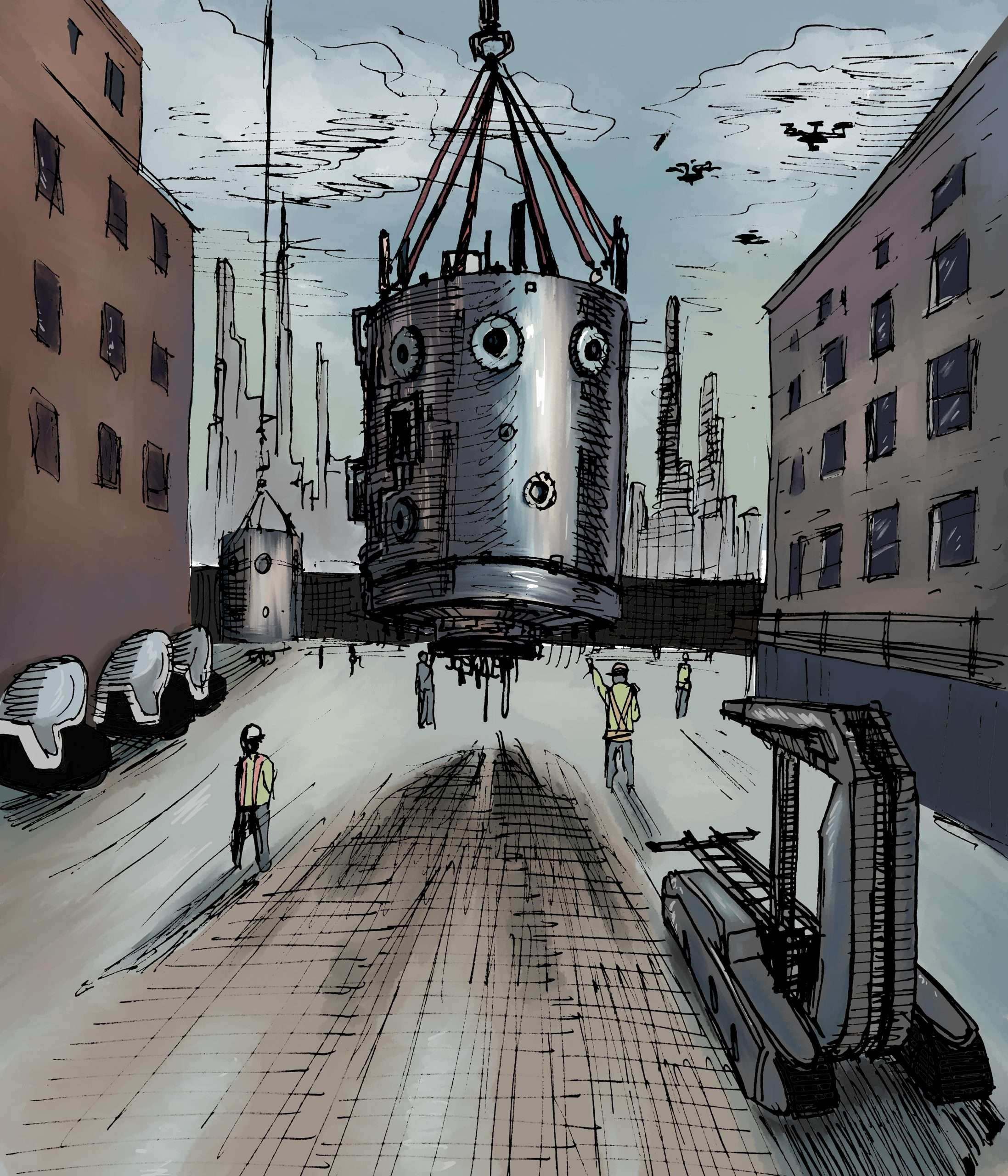
Anticipating protests, the New York Power Authority chose a cold November night—two hours past midnight to be exact, to move the giant barges carrying three new SMR reactors down the East River and into the Navy Yards where they are to be installed.
The activists had assembled a mini-naval blockage.
The Zombie-Clamshell Alliance (ZCA), as they call themselves, were dressed for the occasion and season-appropriate. From the shore, we witnessed the eerie sight of boats of grey-skinned, blood-oozing zombies in the murky waters as the enormous barges approached. In one boat, the activists had dressed as skeletons with dead flowers in a nod to today’s Dia de los Muertos. The ZCA was projecting illuminations onto the approaching barges:
“1,000,000,000 years of death,” read one.
“NYPA, Shove It Up Uranium!” read another
On shore, a small gathering of ZCA leaders was waiting for us with statements. Among them was Caitlin Astor-Conrad, a 102-year-old nuclear activist. Wearing a silver hazmat suit, the wheelchair bound activist recalled her own legacy of protest.

“I’ve been protesting nuclear power for over 75 years, since back in the days of the Clamshell Alliance. Nuclear power has always been a bad idea—and it’s a bad idea people seem to keep on having. This stuff never goes away. It has the power to make the land uninhabitable for humans. And it’s not too late to send it back out of our city.”
From the shore, we witnessed the eerie sight of boats of grey-skinned, blood-oozing zombies in the murky waters as the enormous barges approached. In one boat, the activists had dressed as skeletons with dead flowers in a nod to today's Dia de los Muertos.
“I don’t care how many AI billionaires think this is a great idea,” added Conrad. Remember Fukushima? What happens when the Navy Yard floods again, as it did in 2032?”
But not far from Ms. Conrad, a group of counter-protestors had assembled.
“We had to come out and show some support for NYPA,” said Felicia Santos. “We can’t let the Perfect be the enemy of the Good. Look, I’m part of the Naked Earth Movement. We’ve been protesting solar sprawl. Seemed like a great idea before it was built, but there’s barely any land that’s not hidden by plastic anymore—the earth is crying out, the sprawl has got to stop! And last year’s battery fire should make people think twice about expanding renewables. This reactor is going to power up what, 25% or Brooklyn, just from a fraction of the Navy Yard? Go NYPA!”
Santos was referring to the multiple fires in lithium-ion battery warehouses in 2042-43, which burned uncontrollably when the facility overheated. Entire city blocks were lost in chain-reaction blazes that raged for days, leading to widespread distrust of large-scale battery storage. When battery fires start, they can’t be put out with water.
Soon after, the unmistakable buzzing of NYPD Prowler drones was heard. The drones cleared the activists away with sound-weapons, and the barge docked. By morning, the equipment was unloaded. We caught up with NYPA’s nuclear spokesperson, Tania Shandikar.
I don't care how many AI billionaires think this is a great idea. Remember Fukushima? What happens when the Navy Yard floods again, as it did in 2032?
“Small Modular Reactors (SMRs) are successfully powering cities all over the world,” says Shandikar. “New York has been using new-era nuclear for ten years already, but there hasn’t been much protest because they’ve been floating miles offshore. With the recent rise of attacks on the global supply chain, floating nuclear power is too dangerous. Maintenance ships can’t reliably make it, which is a great cause for concern, because maintenance is very difficult with those molten salt reactors, and the intense neutron radiation in the reactor core causes embrittlement and structural weakening. Without maintenance, you can get a catastrophe, not to mention piracy. We needed a new solution.”
The ACE Engine
“These Reactors coming to Brooklyn are State-of-the-art ACE Engines,” continues Shandikar. “The NYPA council has been monitoring this technology for years. It uses recycled weapons fuel, and it’s very efficient. No need for exotic uranium mixes that come from afar. That means we can maintain the new Distance-Mapping standard.”
NYPA has lately adopted the Distance Mapping Standard, which mandates that materials can’t originate from long distances from their final site.
The ACE engine breakthrough came in 2032 with an internal combustion nuclear reactor designed by Mark Adams, a reclusive engineer with a history of struggling to secure investment. Backed by an anonymous billionaire, ACE used repurposed uranium from Cold War-era stockpiles—an abundant domestic resource—to generate “nanofuel” for the engines. Nanofuel generates massive amounts of energy at a fraction of the cost of traditional nuclear plants.
“This will 100% bring down energy costs to New Yorkers,” says Shandikar.
Backed by an anonymous billionaire, ACE used repurposed uranium from Cold War-era stockpiles—an abundant domestic resource—to generate 'nanofuel' for the engines. Nanofuel generates massive amounts of energy at a fraction of the cost of traditional nuclear plants.
Similar SMRs will be deployed at the Ravenswood Generating Station in Queens, the Arthur Kill Generating Station in Staten Island, and the Hunts Point Energy Hub in the Bronx, all strategically placed to leverage existing transmission infrastructure while minimizing community impact.
All the same, the reactors are unlikely to be built without a healthy amount of protest.
“We’ll be back tomorrow,” promises Astor-Conrad, as she wheels herself off to take a rest.
“Protest is the New York way, but so is using lots of energy, and this is an efficient way to provide that,” says Shandikar.