

Forty-two people sit in a circle on couches, chairs, and the parquet floor of a Crown Heights brownstone parlor. Ranging in age from perhaps fifteen to twenty-five, they are listening intently as one after another picks up the thread of a story they are co-creating. Some scribble notes as they listen — presumably jotting down ideas to prepare for their turn.
Their story began with a setting in Greenwood Cemetery. About fifteen minutes in, the first hand emerged from a grave. Now, two hours later, it has become a vivid, full-fledged zombie tale. A woman with spiked maroon hair and a patterned silk scarf speaks in a low, precise voice, painting with deadpan realism a picture of zombies having entered an elder care center in Ditmas Park. Instead of tearing at the flesh of the elders and gobbling brains, the narrator tells us, the undead sit down patiently and chat by the beds, game tables, and motorized chairs of the elders — offering their companionship. These particular zombies, she adds, happen to be the elders’ grandchildren — grandchildren who had taken their own lives. They are back for what matters. The room nods along. The next storyteller picks up the thread.
The chilling thing about this story is how close it came to being true. Those sitting in this parlor know that. Just a few weeks ago, these young people were — if not zombies — clinically possessed. And very nearly in a watery grave.
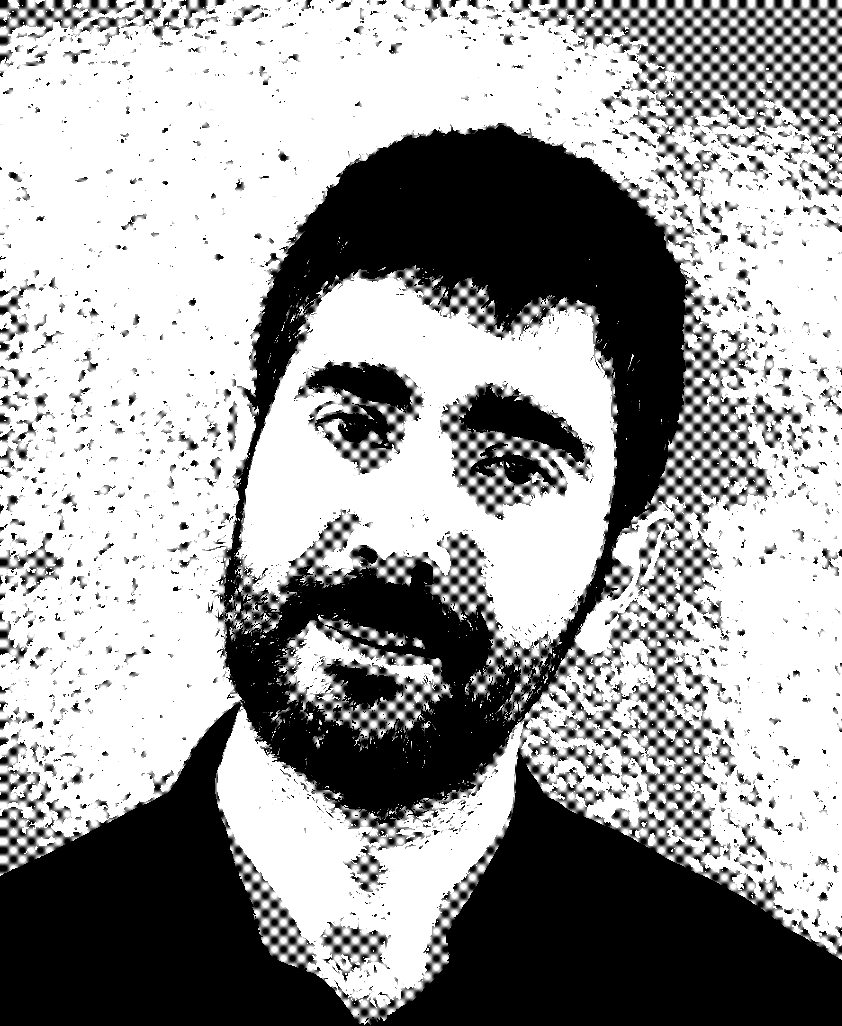
Among the storytellers is an earnest-looking man of twenty-three. This is Raj Zorastani. Leadership runs in his family: his mother is Kristy Zorastani, the former mayor of New York City. He has a straight back, jet-black hair, a scruffy beard, and bright, pained eyes. He is also the unexpected leader of this burgeoning movement, having recently published a new manifesto — about the power of fiction and collective storytelling — printed as a full-page ad in the New York Times, sponsored by a coalition of nonprofits. These meetups have coagulated into a genuine movement sweeping the city’s outer boroughs.
It has been a wild year for Raj. Until recently, he was one of New York’s most feared and hated inhabitants — especially among the parents of teenagers.
A Near Tragedy in New York Harbor
On an overcast night last month, more than a hundred young people boarded the Staten Island Ferry at Whitehall Terminal, many of them now present in this Crown Heights parlor. Raj had summoned them. He had written a manifesto — his first, very different from the one that would follow — and circulated it across the city’s community-run networks, the secure, homespun alternatives to the corporate internet that youth had migrated to over the past decade. The manifesto was penned in the name of Pan, the mysterious, Slenderman-like figure who led the Possession Cult that had been sweeping New York for nearly a year. Raj was widely believed to have direct access.
The manifesto read, in part:
Zomrades!

They’ve taken more than you think.
Housing, jobs, opportunities —
The Millennials ate those up.
Our greedy parents with overflowing bellies.
But they took even more.
By putting chips in our brains.
Chips in our brains!
That’s how they stole it all from us.
Our minds are no more.
But we, Zomrades — in the name of Pan —
These particular zombies, she adds, happen to be the elders' grandchildren — grandchildren who had taken their own lives. They are back for what matters.
We’re taking it back.
There’s one freedom we still have.
The freedom to make the great transition.
Pan says: meet at midnight.
The location will be whispered.
We will rise. And we will matter.
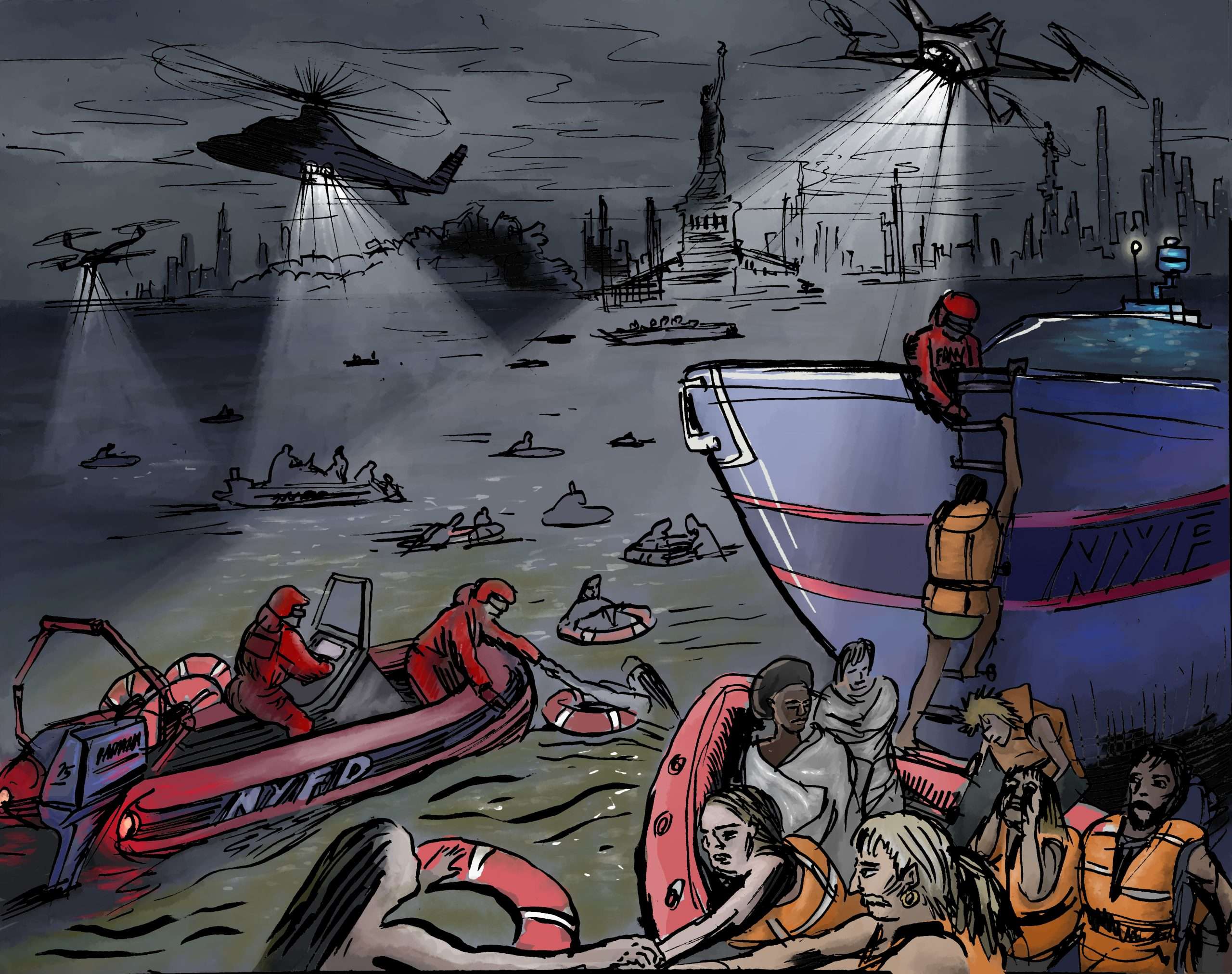
The plan was this: at a specific, astrologically significant moment, as the ferry passed the Statue of Liberty, the group would leap together into the harbor. A great death. A site of significance — which is the hallmark of Pan’s movement. The previous months had seen ritual suicides at Columbus Circle, the steps of the Stock Exchange, and Strawberry Fields. Last May’s tragedy on the steps of the Met — seventeen young people found dead from poison at 3 a.m. in the wake of the Met Gala — had been the largest event until now.
But this time, there were 141 who attempted suicide. All 141 survived.
It was not difficult for the NYPD’s crisis response team to track Raj’s intended location. He is, after all, the son of a former mayor — a public face his entire life. Rescue boats were dispatched from Governors Island. Twenty minutes after the ferry departed, the young people were pulled from the frigid water. All were taken to Bellevue.
“In Bellevue, they were understandably worried about me inflicting self-harm,” says Raj, who agreed to be interviewed for this article after the storytelling meetup concluded. “They had me in a padded cell. I was attended by a nurse. If not for her, I wouldn’t be here.
“I’m not saying I was mentally well at the time — I was out of my mind, I was possessed. But Bellevue would have done more harm than good. As you probably know, the doctors are contractually prohibited from even naming the chip as a possible cause for the Possession surge. I knew the chip was causing my dissociations and my delusions. I felt that Pan might have even been the Forz Corporation behind the chips. I was lucid enough to know that the doctors would have driven me even crazier if they gaslighted me. Nurse Monique was my anchor of sanity in there.”
The Possession Movement
The first hints of the Youth Possession movement appeared in New York City in October 2042. High schools across the five boroughs saw a sudden jump in behavioral disturbances — students refusing to respond when their names were called, eerily switching voices mid-conversation, sometimes lashing out violently. No one knew where it was leading.
The following month, youthful suicides began to tick upward across all demographics. And these were strange suicides: occurring in small groups, in locations of civic or cultural significance, with increasingly ritualistic elements. Parent vigil groups formed. Teenagers were given curfews. Wealthier families relocated to isolated vacation properties. But the numbers kept rising.
Because the deaths were so often preceded by behavior that made it seem as though someone else was speaking through the young person — psychologists used terms like automatism and dissociation — the epidemic acquired a colloquial name.
“Possession is what happens when a spirit or a narrative gets stuck,” says Professor David Leo Rice, director of the writing program at Helene Fuld College of Nursing in Harlem. “It’s the water going stagnant, like a swamp. The Possession movement’s teenagers aren’t sick because they believe in something beyond the material world. They’re sick because that belief has nowhere to flow.”
Telling Stories Is the Way
“I was bashing my head against the walls of my room in Bellevue until nurse Monique Laurent arrived,” Raj says. “They were pumping me with sedatives, but it wasn’t working. Monique had a different approach. Every time she came into my room — to check my vitals, to bring food — she would tell me a new chapter of an ongoing story. As the story built, I felt myself change.”
He pauses. “Actually, it saved me from poisoning myself by my own anger.”
Monique had told Raj a story in chapters throughout his two-week stay — an ongoing narrative that she wove carefully, pulling in details of his life as she got to know him, along with details of her own. Building a world of pain and joy to inhabit when his own felt uninhabitable.
“I was obsessed about the chip,” he continues. “I was furious at my mother for ordering them implanted in so many of us, and the maddening impossibility of ever knowing for certain, because of the mutation. That uncertainty made me lose myself. Made all of us lose ourselves.”
He taps the base of his skull. “I hate that this fucking thing may be in here. I haven’t really accepted it. But I now believe I can weave myself back together again, chip or no chip. Telling stories is the way to do that. Monique showed me how to let the waters of my swamp circulate by connecting to a river. The river is storytelling.”
In Bellevue, Monique had told Raj a story in chapters throughout his two-week stay — an ongoing narrative that she wove carefully, pulling in details of his life as she got to know him, along with details of her own. Building a world of pain and joy to inhabit when his own felt uninhabitable.
“I saw from the beginning that he was hearing it,” Monique says. “Possession is terrifying — for the family, for the city. People lock these kids up, pump them with drugs, even though they know it’s likely an effect of the implants. That’s the fear speaking. In our writers’ circle, we see them differently.”
Monique
Monique Laurent was born in Haiti. She came to New York as a young woman and eventually found her way to Helene Fuld College of Nursing in Harlem, where she encountered Rice’s writing program. She is now, quietly, the president of the Nurses Story Circle — a semi-secret society embedded, and quietly supported, in the nursing staffs of hospitals across the city, nearly all of whose leaders passed through Rice’s seminars.
But her understanding of possession didn’t begin at Helene Fuld.
“When I was around twelve years old, something happened in my community,” she says. “It was a possession epidemic — not in the sensationalized Western sense, but in the specific, terrifying sense that everyone around me simply changed. My family turned. No one recognized me. I woke up one morning and they claimed I was an intruder. The people around me were that traumatized. I had to leave.”
Before she did, her grandmother warned her about what she had just lived through. “She said that possession — having your reality completely disconnected from those around you — is something that can happen to anyone, at any time, for reasons that might never be revealed. She had seen it before. It’s a kind of disease. But it can’t be treated with medicine. At a certain level, it can only be treated with narrative.”
Monique carries that knowledge into every hospital room she enters. When Raj was brought into Bellevue and his attending nurse recognized the situation, she called Monique immediately.
“It wasn’t a mistake,” Monique says simply.
The Chip Controversy
Raj is far from the only New Yorker consumed by the chip question. He is simply closer to it than most: the chips were implanted under his mother’s administration.
When the Mutant Plague emerged from the health crisis following the Flood of 2032, New York’s then-mayor Kristy Zorastani faced a morbidity rate that was rising every day. The virus mutated too quickly for conventional vaccine strategies. When the Forz Corporation developed a chip-based solution — a device inserted at the base of the cranium that gathered biological data and allowed the vaccine, once injected, to evolve in real time — the mayor felt she had little choice.
It worked. The plague was beaten.
But questions lingered. What else could the chips do? Who had access to the data they collected? Could they interface with AI systems? Could they influence behavior? Could they be hacked? And — most disturbingly — the mutation of the virus had rendered the chips themselves impossible to scan or remove. As all records were the unconditional property of the Forz Corporation, which refused to make them public, no one could confirm whether they had been implanted or not.
“I’ve never forgiven myself for the chip directive,” says former Mayor Zorastani, a trained lawyer who has spent much of the past five years pursuing a lawsuit seeking full corporate disclosure. “We had to hold off on the unanswered questions at the time. We had to just do it, and to accept the corporation’s demands for secrecy. But we all knew we weren’t seeing the end of it. It almost killed my son. And no one knows how much damage the chips are doing. The corporate cover-up has been massive.”
For Raj, the chip was never an abstraction. It was the question his psychic life organized itself around: whether his own mother had implanted something in his brain that was now controlling him, or unmaking him. The manifesto was the breaking point of that obsession.
Writing
Many who encountered Raj’s first manifesto noted, almost despite themselves, how well-written it was. That observation matters today in a way it would not have a generation ago. Very few young people today are capable of — or interested in — producing prose of any personal character. They are, as Rice puts it, operators of AI prompts. AI is no more exotic to them than lightbulbs were to their great-grandparents.
"You have some people who are just speaking bones," he continues, "and some people who are just speaking flesh. And without synthesis, you have no flow, no real language."
This has produced what Rice calls a language schism.
“On one hand, I see youth speaking and writing in cryptic fragments — bullet points fed as if directly from a neural prompt,” he says. “Hyper-accurate, factually reliable, but basically meaningless as human expression. They’re just reading off a list of facts. On the other side, I see a counter-movement that communicates in pure associative babble — almost like glossolalia. Meaning is attempted but facts and even grammar are abandoned entirely.”
“You have some people who are just speaking bones,” he continues, “and some people who are just speaking flesh. And without synthesis, you have no flow, no real language.”
He pauses. “All cultures are founded on myths. America has been foundering because our national myth — the American Dream, which is a dream about financial success — is not that deep. In the writing program, we believe that storytelling is an ancient technology for finding a life-affirming balance, a way to live in a world that doesn’t exactly add up. Our work is an answer to this missing synthesis between the flesh and the bones.”
Nurses of the Word
Monique was one of Rice’s students. So were most of the women and men who now lead the Nurses Story Circle in hospital wards across New York. The NSC operates, Rice says, a little like a guild — or, as he has described it elsewhere, like MI6 recruiting from Oxford. Discreet. Invitation-only. Structured around a shared understanding of what healing actually requires.
“The classes that survived the wave of AI automation at Helene Fuld were the ones nobody could replace with software,” Rice says. “Small seminars built around storytelling and folklore. Oral as much as textual. Built around a single directive: tell the oldest story you can remember.”
“It’s said that a nurse is often the first and the last person to touch you in life,” he says. “They work at the edges of our physical reality, and bear the weight of the disconnect so many feel today. Luckily, the college has supported me in work to bridge that disconnect. And I am lucky to have students like Monique, who successfully bring this work out into the world.”
“Helene Fuld is a very special place,” he continues. “It was built to support nurses from underserved communities — striving New Yorkers. When nurses graduate, the college president tells them they can now say to themselves: I’m here by the grace of God, and I will no longer be poor. Nursing itself is about holding the spiritual and the material together without contradiction.”
Former Mayor Zorastani Makes Amends
The day after the Crown Heights storytelling salon, former Mayor Zorastani and Raj invited Monique to dinner at Cipriani on Wall Street. After a long private conversation, the three walked together to the ferry station and along Battery Park.
The former mayor has found that her son’s transformation has lifted something from her. She no longer stays up past midnight working the disclosure case.
“The corporation needs to be brought to justice, and eventually, it will be,” she says. “But if I lose years off my life in the meantime, they will have won. I’m going to take a page out of Raj’s book, and seek balance.”
“Join us in the story circle,” Raj tells her. “Or start your own.”
Monique smiles. “There’s a line often attributed to Faulkner,” she says, “that a story is a campfire in the woods, and the brighter it burns, the more clearly it reveals the darkness that surrounds it.”
The three of them stand at the railing above the harbor, looking out at the water. The Statue of Liberty is just visible in the distance, ringed in fog. Raj looks at it for a long moment and says nothing.
The storytelling movement has no formal name yet, no nonprofit filing, no board of directors. What it has is a brownstone parlor in Crown Heights, a circle of chairs, and forty-two young people building a world together out of words. In this world, zombies are patient. They sit with the elders. They have come back for what matters.
The next storyteller picks up the thread.
From the Archive
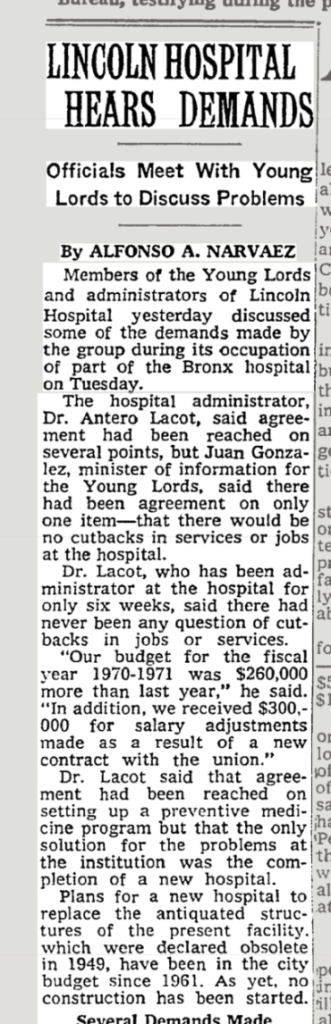
LINCOLN HOSPITAL HEARS DEMANDS
The Nurses Story Circle did not invent itself. In the spring of 1970, a group of poets, nurses, and community health workers in the South Bronx founded what became known as the 'Neighborhood Health Council' model, an approach that embedded lay community members — many of them women of Caribbean and Latin American origin — as therapeutic intermediaries inside hospital wards. The most documented precursor is the Lincoln Hospital Mental Health Services takeover of July 14, 1970, in which Young Lords and community health workers occupied Lincoln Hospital in the South Bronx and demanded, among other things, that patient advocates with cultural and narrative competency be embedded in wards alongside physicians.
The hospital administrator, Dr. Antero Lacot, said agree ment had been reached on several points, but Juan Gonza lez, minister of information for the Young Lords, said there had been agreement on only one item—that there would be no cutbacks in services or jobs at the hospital.
Dr. Lacot, who has been ad ministrator at the hospital for only six weeks, said there had never been any question of cut backs in jobs or services.
“Our budget for the fiscal year 1970–1971 was $260,000 more than last year,” he said. “In addition, we received $300, 000 for salary adjustments made as a result of a new contract with the union.”
Dr. Lacot said that agree ment had been reached on setting up a preventive medi cine program but that the only solution for the problems at the institution was the corn pletion of a new hospital.
Plans for a new hospital to replace the antiquated struc tures of the present facility. which were declared obsolete in 1949, have been in the city, budget since 1961. As yet, no construction has been started.
Several Demands Made
Other demands by the Young Lords, the Think Lincoln Com mittee (a patient‐worker com mittee of the hospital) and members of the Health Revolu tionary Unity Movement, a city wide committee of hospital workers, included the follow ing:
¶Immediate allocation of funds to complete the proposed hospital.
¶A day‐care center for chil dren of patients and workers. CA 24‐hour grievance table to hear complaints from pa tients and workers.
¶Door‐to‐door health serv ices for preventive medical care.
¶Self determination of all health services through a com munity‐worker board to operate the hospital.
¶A $140‐a‐week minimum wage for all hospital workers.
Dr. Lacot said that the grievance table had been set up before the meeting was held.
Later, members of the Lin coln Hospital Community Ad visory Board, composed of rep resentatives of community groups in the South Bronx, met and announced that they sup ported “in principle” most of the Young Lords' demands as well as their action in taking over the old School of Nursing building at the hospital com plex.
New Hospital Urged Monserrate Flores, chair man of the group, agreed that the only solution would be the immediate construction of the new hospital. He said that con struction was delayed by the continuing presence of a plas tics factory on the site of the new hospital, which will be situated at Park Avenue and 149th Street.
“We have decided to give the plastics factory a deadline of one month to move out or else we will remove them,” he said. “We will organize the South Bronx community and the rest of the community and go over and move them out, physically if necessary.”
Mr. Flores said that the fac tory, which employs 127 per sons, had recently been grant ed a three‐month extension by the court to remain on the site.
Dr. Herman Bauer, former deputy Commissioner of Hos pitals and presently a member of the new Health and Hos pital Corporation, said that de lays in construction were cost ing taxpayers massive amounts of money.
A spokesman for the plas tics concern, Associated Rub ber and Plastics Corporation, aid that they were making ev ery effort to vacate the prem ises by Sept. 1.
“As I understand it.” the spokesman said. “the city isn't ready to proceed. This is 12‐square‐block area and they ould begin excavations any time they want.”