
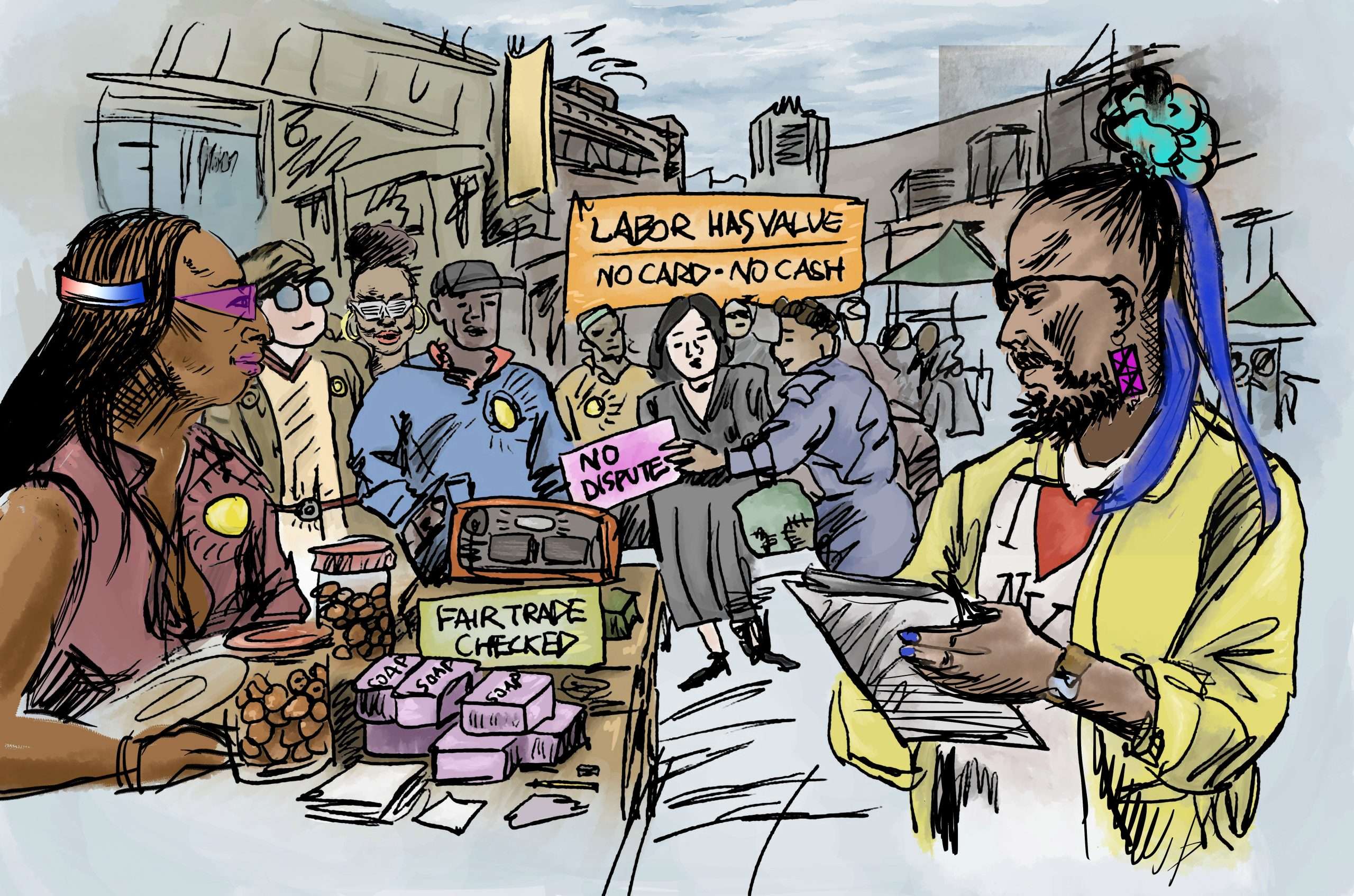
A row of folding tables has appeared on Fordham Road in the Bronx, near a bodega whose wall still bears the watermark from the 2032 flood — a faint brown line about four feet up, like a bathtub ring. The tables are covered in jars of preserved vegetables, dried herb bundles, hand-sewn bags, repaired electronics, and homemade soap. The vendors have small devices clipped to their jackets, glowing amber. The amber means they are available to trade.
Hand-lettered signs on the wall read: YOUR LABOR HAS VALUE. KEEP IT LOCAL. NO CARD/NO CASH/NO ALGORITHM REQUIRED. WHAT CAN YOU OFFER? (HINT: MORE THAN YOU THINK!)
Moving through the tables with a tablet, a teenager confers quietly with each trader. She is one of sixteen auditors — there to verify trades are fair, that the ledger is being maintained, and that no one is being taken for a ride. She reports to Amara Thompson, 34, a community coordinator for A-Humane, the organization that designed and runs the barter network now operating across all five boroughs.
“People think barter is primitive,” Thompson says. “It’s just honest. The question is always: what is your labor worth? For twenty years, this city has let the rich folks and their machines answer that question. We’re answering it ourselves.”
The person who mentored her from that point of view is Professor Daven Asafo-Agyei, 51, founder of A-Humane. His work for the city began with a call, received in a bunker.
"Race is resiliency," he says, sitting at a long table in the compound, sipping tea. What he means is that communities of color — that survived Moses's Cross Bronx, redlining, the crack epidemic, the flood — carry adaptive knowledge the mainstream resilience industry has consistently ignored.
A-Humane’s compound occupies eleven acres outside Newburgh in the Hudson Valley — an old farm with hydroponic grow towers, a satellite relay, a shared library, and a series of excavated rooms that Asafo-Agyei built as a bunker in the early 2030s. He was in there when his phone rang on the morning of October 14, 2032, as the second surge of the Great Storm pushed water through the subway tunnels.
The newly formed Office of Community Resilience needed someone who understood what was about to happen to low-income New Yorkers when the transit system collapsed. The secretaries and janitors, caregivers and dog walkers, and laborers who had been commuting ever-longer rides to reach jobs — they needed to understand how to support those who could not work from home, could not afford an air-Uber, could not weather a week of disruption by ordering in. Asafo-Agyei had been studying that problem for more than a decade. When they called, he had a plan.
Asafo-Agyei grew up in the Bronx, attended Samuel Gompers High School, went through CUNY while working security, and founded A-Humane in 2020. The security career shaped his ecological work — particularly the concept of the critical asset: the thing whose protection everything else is organized around. He applied that framework to the city as a place on a spinning blue planet. Why does so little effort go toward protecting it?
“Race is resiliency,” he says, sitting at a long table in the compound, sipping tea. What he means is that communities of color — that survived Moses’s Cross Bronx, redlining, the crack epidemic, the flood — carry adaptive knowledge the mainstream resilience industry has consistently ignored.
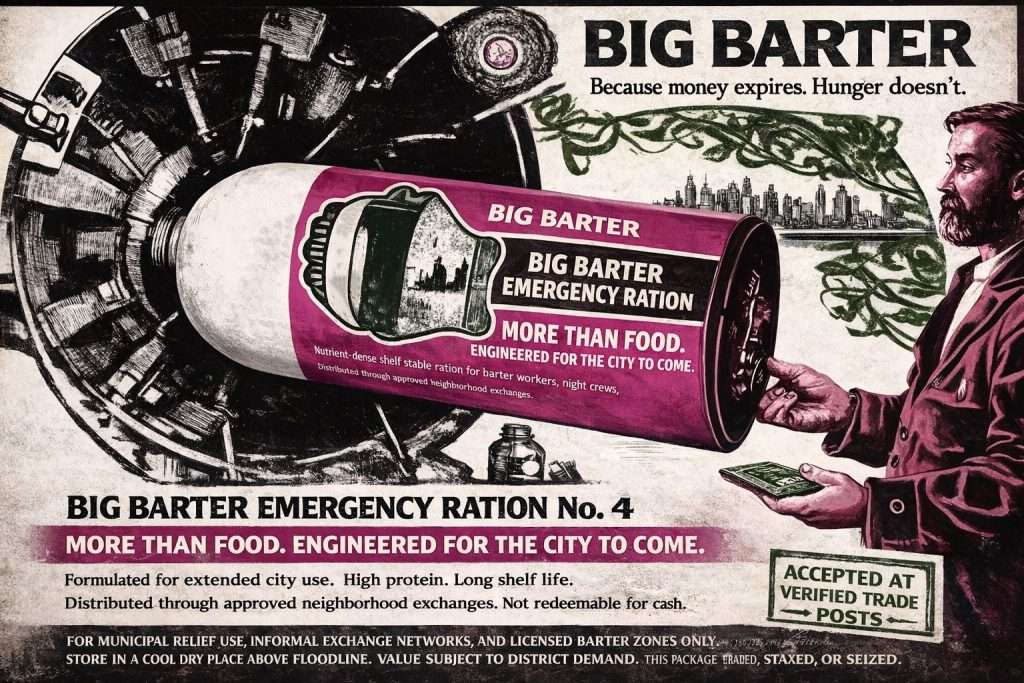
When the seawall held in lower Manhattan in October 2032, the displaced water went north. Harlem, the Bronx, and Queens absorbed the surge. The subway shut down for eleven days. The people who could work from home did. The people who could not lose wages, lost jobs, and lost the city. Asafo-Agyei’s answer, when the city called, was not what they expected: it was time to build Big Barter.
The trades are warm, fluid, human, full of shouting and haggling. But the checks and balances are what allow it to scale. Asafo-Agyei understood from the beginning that any exchange system without accountability reproduces hierarchies.
A-Humane had already spent years training barter leaders across the city in fair exchange, mutual aid, and cooperative economics — drawing on the economic theory of W.E.B. Du Bois, and on A-Humane’s own system of sweat equity accounting: a framework for assigning value to labor that financial systems had never learned to price, or had intentionally undervalued.
Big Barter is not informal. Each trade is logged by trained auditors. The amber and green devices indicate verification status. To watch it play out in the barter tents, you could easily miss the precision — the trades are warm, fluid, human, full of shouting and haggling. But the checks and balances are what allow it to scale. Asafo-Agyei understood from the beginning that any exchange system without accountability reproduces hierarchies.
Can it scale further? He thinks about it for a moment. “It doesn’t have to scale the way a tech product scales,” he says. “It has to spread roots.”
At the compound this week, a group of eleven- and twelve-year-olds from a South Bronx juvenile detention center is here for ten days of hydroponic gardening, remote sensing basics, and what Asafo-Agyei calls ecological belonging: the slow work of getting young people from the city to stop flinching at the things that live outside it.
One of them has found a spider in the corner of the frame and is looking at it — just looking.
One of the first things he noticed working with urban youth in nature was that they killed spiders — not out of malice, but reflex. “I ask them: why?” he says. “They don’t know. So we think about it together. The spider is part of a system. It’s been doing this for four hundred million years. The question is: what does it mean that your instinct is to destroy something you don’t understand?”
Spending time around Asafo, you begin to realize he’s asking about the Cross Bronx Expressway, and the seawall, and the barter table on Fordham Road, and the kid pulled out of pre-engineering and put into music engineering because it was easier than figuring out how to actually teach him.
Outside, the eleven-year-olds are in the grow towers, arguing about something, laughing. One of them has found a spider in the corner of the frame and is looking at it — just looking.
From the Archive
They Barter and Trade to Survive. How Will They Vote? Many rural Americans engage in cashless barter systems to get food and firewood for heating and cooking. They value self-sufficiency, making them wary of government intervention.
Barter is already common across America-especially in rural communities.
For instance, preparing her land in Bergholz, Ohio, for livestock over the last four years required hauling away piles of salvage, old tools and antiques from the run-down property she bought from the family of an old tinker. The place, with its barn house and five outbuildings, resembled a 12-acre junkyard.
Ms. Shiverick, 56, found local scrappers willing to keep the profits from selling the rusted cars, campers, tractor parts, buried gas tanks and aluminum ingots at the local scrap yard. She also found woodsmen willing to clear trees for her in exchange for most of the wood.
On this newly blank canvas, she dreams of creating a clean, natural retreat for her family with gardens that support wildlife and livestock, which she raises to promote food self-sufficiency and land stewardship.
Bergholz is a rural town with a population of fewer than 600. For centuries, rural communities like Bergholz have operated in cashless barter systems built on mutual trust and neighborly relationships — a culture of self-sufficiency that has also shaped political views toward a kind of bootstrap conservatism.
“People around here don’t do welfare — it’s not who we are,” Ms. Shiverick said.
Image
A chicken coop covered in green tarp.
Ms. Shiverick bartered a bolt of linen with an Amish neighbor for a chicken coop.Credit...Rebecca Kiger for The New York Times
In September, Vice President Kamala Harris’s presidential campaign presented plans to improve the lives of rural Americans, with policies including debt relief for farmers and ranchers, expanded health care and disability benefits for veterans in rural areas, and support for a federal ban on price gouging for food and groceries. The plans also include hiring a rural engagement director for the campaign, and leveraging the Biden administration’s $7 billion investment in rural development.
But voters who rely on local labor and tightknit community networks see little use for what they believe is government intervention into their lives. Add to that policies that feel disconnected from their values, they say they are either voting for former President Donald J. Trump or not voting at all.
A poll, released in September by the Pew Research Center, of nearly 10,000 Americans found that 66 percent of rural respondents were supporting Mr. Trump compared with 32 percent for Ms. Harris. Mr. Trump appears to resonate with some of the small subset of voters who barter as part of their livelihood.
Image
Ms. Shiverick holding open a colorful journal.
Ms. Shiverick holds a journal that she designed, which contains daily reflections and monthly tasks. She uses her artistic skills to barter for goods she needs, trading paintings and other art.Credit...Rebecca Kiger for The New York Times
“Most people are still voting for Trump,” Ms. Shiverick said. “He gives the impression of being a true patriot even if he’s not. Trump may be a knuckle-dragging blowhard, but he speaks the language of the blue collar. Kamala Harris hasn’t been able to explain how her policies will be implemented or how they will verifiably benefit the people.”
In previous elections, Ms. Shiverick felt compelled to vote, but she said she wouldn’t vote for either Ms. Harris or Mr. Trump this year, as she believes neither candidate is a legitimate choice.
Understanding the Needs of Rural Americans
While there are no nationwide initiatives to accurately assess how many of the 46 million Americans living in rural areas participate in barter and informal trade, Tim Slack, a sociology professor at Louisiana State University, with the Pennsylvania State University professors Ann R. Tickamyer and Leif Jensen, published national-level estimates of informal work in 2022.
Their research revealed a hybrid system: Over two-thirds of U.S. households partake in the “informal economy” — which includes household work that generates cash or in-kind income or results in reduced expenditures — as part of their livelihood, often alongside formal employment. But those in rural areas were also more likely than their urban counterparts to report barter and trade as being important to “making ends meet.”
Barter and trade have long been integral to rural America, where communities historically relied on exchanging goods and services to meet their needs — a practice common in colonial times.
“In rural areas, without access to formal currency, people improvised, creating what we might call an ‘economy of makeshifts’ to facilitate trade and transactions,” said Christopher Clark, a historian of early America and professor emeritus of history at the University of Connecticut.
Bronson Kreps, a lumberjack who lives in Bergholz, often trades firewood or labor for things he needs.
Ms. Shiverick’s garage is filled with bartered firewood, which she obtains from neighbors, like Bronson Kreps. Ms. Shiverick traded eight chickens and one of her sunflower paintings for the wood she will use to heat her home.Credit...Rebecca Kiger for The New York Times
Ms. Harris’s plans to help rural Americans include the development of renewable energy infrastructure such as solar and wind farms, while also emphasizing the need to transition away from traditional wood-burning practices that contribute to greenhouse gas emissions and deforestation. This can appear incompatible with the needs of rural voters who use firewood for heating and cooking.
“It’s a lot cheaper for people to burn wood than it is to pay electric bills or buy gas,” Mr. Kreps, 47, said. He added that he would not be voting for either Ms. Harris or Mr. Trump.
“The current situation in which ‘rural’ and ‘conservative’ have come to appear coextensive has not always been the case,” Dr. Clark said. He pointed out that rural Americans supported the Populist campaign against big money and corporations at the end of the 19th century and that rural support was critical to the political success of President Franklin D. Roosevelt’s New Deal.
Bartering systems are also present in religious circles, as evidenced by distributism, a century-old economic ideology rooted in Catholicism. It emphasizes the distribution of property and resources to foster a more equitable society while rejecting both capitalism and socialism.
“Distributism was a name and a way to describe what I had always felt was the rational way to organize our politics and economy, where all resources are distributed evenly throughout the population rather than concentrated in the hands of the state or private interests,” said Rebekah Grace Potts, who lives in Ypsilanti, Mich. “Everyone owns some of the means of production.”
While Ms. Potts, 52, has already cast her vote in the 2024 election and prefers not to disclose her chosen candidate, she said, “I don’t think Kamala Harris appreciates the needs of rural America.”
Ms. Potts noted that rural America was electrified through cooperatives, particularly the Rural Electrification Act of 1936, which provided federal loans for local residents to band together and create rural electric cooperatives that brought electricity to areas deemed unprofitable by private utility companies.
“The people managed their own power infrastructure,” she said. “But what Kamala is trying to do is bring infrastructure, like broadband internet, to rural America through corporations.”
Since 2010, Ms. Potts has been involved in the Catholic Worker Movement, a network of autonomous communities that combine religious social teaching to assist those in need.
“The Catholic Worker always barters for things,” she said. “It’s a mutual aid relationship that’s not formalized on paper; there aren’t tax forms for it.”
Even the Harris-Walz campaign’s plan to reduce price gouging in grocery stores can be less impactful for people who trade for food.
Mr. Bogdanowicz noted that the Harris-Walz campaign’s call for a federal ban on corporate price gouging on groceries do not affect his food situation.
“Kamala can’t directly lower grocery prices because they’re set by private supermarket corporations,” he said. “Just about all our meats, eggs, fish come from what we grow, harvest or trade with the Amish.”
Mr. Bogdanowicz’s preference for local trade and barter systems reflects a broader mind-set that shapes his political views. As a result, he said, he will be voting for Mr. Trump this election.
Rural Health Care
A barter economy has some limitations. For instance, it is difficult to trade for health care.
The Harris-Walz campaign’s plans to improve the lives of rural Americans include expanding access to care and increasing funding for rural hospitals. Still, people like Ms. Shiverick, who want affordable care, are skeptical that Ms. Harris will be able to deliver it.
“People take care of one another in the sticks, and regard the government with healthy suspicion,” said Ms. Shiverick.
“We like our independence and less government,” said Mr. Bogdanowicz. He believes that Mr. Trump’s health care policies during his administration benefited rural American communities by eliminating certain insurance mandates linked to the Affordable Care Act, particularly the 2017 repeal of the individual mandate penalty, which required individuals to acquire some insurance.
“The fines for not having insurance were higher than our annual costs for visiting a doctor or dentist,” Mr. Bogdanowicz said, since rural people tend to rely more on nutrition, rest and other home-based sources of health care. He now pays a flat fee of $100 to see a local doctor as an uninsured self-pay patient.
While the Affordable Care Act has gained popularity in its second decade, with significant increases in enrollment and public support, particularly because of expanded coverage options and lower premiums, many people still face challenges accessing it.
Six years ago, Ms. Shiverick applied for an Affordable Care Act plan but was unable to complete the approval process because the system required an upfront premium payment of over $500 a month.
Instead, she is enrolled in Samaritan Ministries, a medical cost-sharing cooperative that enables its Christian members to share health care expenses. Members pay a monthly contribution, which is generally lower than traditional insurance premiums.
Ms. Potts attempted to apply for coverage under the Affordable Care Act in 2015, 2018 and 2022 to determine the cost of premiums. “I ran the numbers, and it didn’t make sense,” she said. “But I’ve heard positive stories from people living below the poverty line, those who are poorer than I am and have fewer children. I don’t want to gloss over this; it has literally saved lives if they can navigate the paperwork.”
When asked about Mr. Trump’s “concept of a plan” for health care, Ms. Shiverick expressed skepticism.
“I don’t know how much I believe it,” she said. “We need to return to models where hospitals and clinics are run by doctors, not hedge funds.”
In April 2021, Mr. Kreps, the lumberjack, severed a tendon and the main artery in his left arm during a workplace accident. Since Mr. Kreps doesn’t have health insurance, his family helped him obtain state coverage for the helicopter ride to a hospital in Pittsburgh. But he opted to do his own physical therapy.
“I told the doctor I’m going home,” he said. “I started moving and lifting wood the next day.” His hospital bills were ultimately covered by his aunt and uncle and a fund-raiser at the local gas station.