


out, was only the beginning.
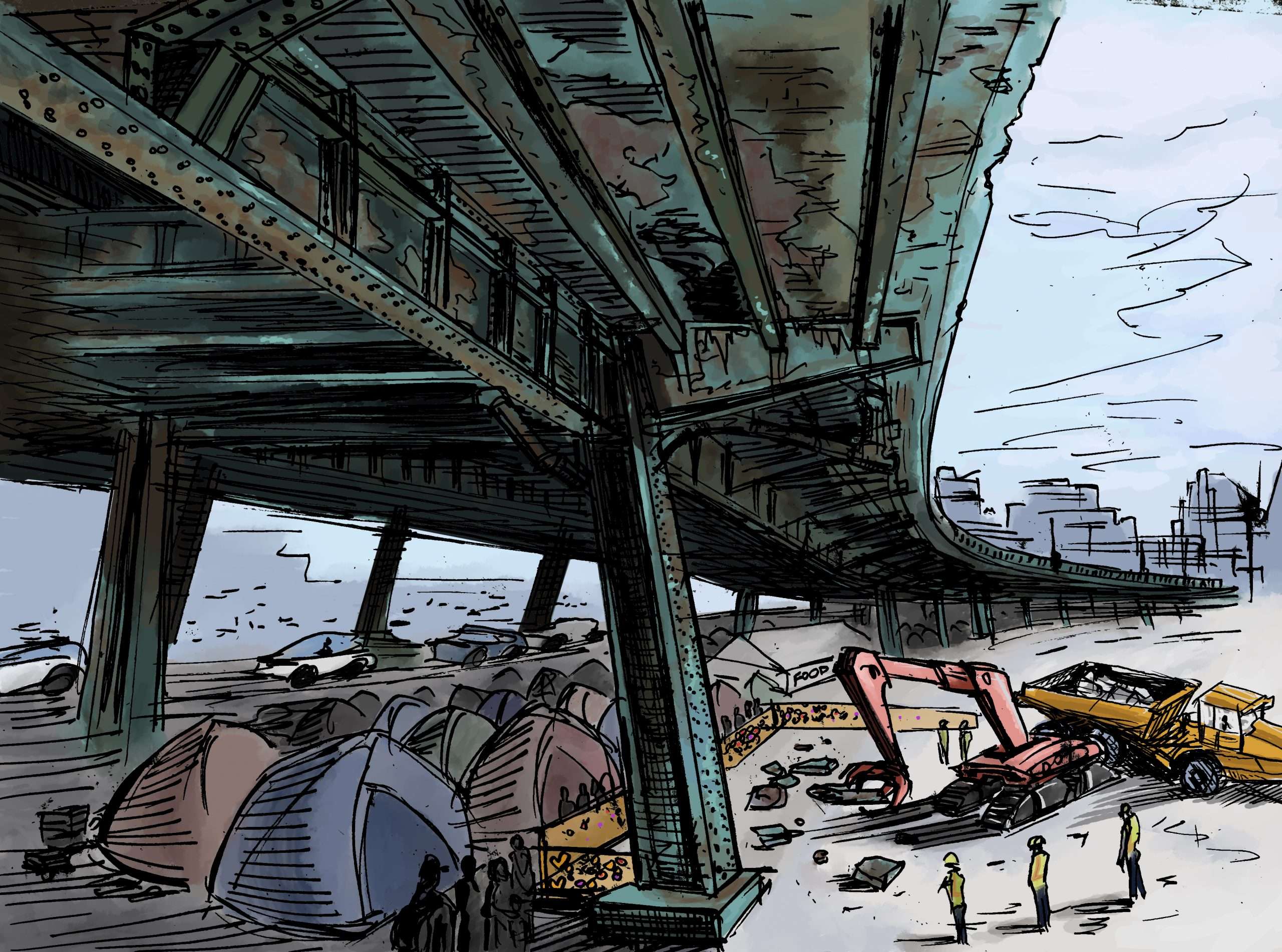
On a February morning, three hundred pounds of concrete broke free from the underside of the Brooklyn-Queens Expressway and fell without warning onto the settlement below. The chunks — each the size of a small refrigerator, loosened by fissures that had been developing for years deep within the salt-corroded steel infrastructure of the overpass — landed on the tent village that has occupied the shadow of the Hamilton Avenue section of the BQE since the Great Storm of 2032. Two members of the Lopez family were killed: Marisol Lopez, 34, and her son Dario, 7. Her husband Ernesto and their daughter survived. They were taken to Methodist Hospital, where Ernesto remains.
The city has since begun relocating the camp’s residents — roughly four hundred people, most of them displaced by the flooding that permanently inundated large sections of the city, from Red Hook and Gowanus — to emergency transitional housing in East New York and Canarsie. The process is expected to take several weeks.
After the chunks were removed, workers began installing scaffolding beneath the entirety of the BQE’s twelve miles, from the Kosciuszko Bridge in the north to the Verrazzano approach in Bay Ridge. The highway is too important to shut down for long. No one can say with confidence how many similar widowmakers hang, silent and invisible, above the 200,000 vehicles that use the road every day. And replacing it will cost an estimated $15 to $20 billion in a city that has been running a structural budget deficit for eleven consecutive years.
Mayor Alicia Nurse knows that New York needs this artery, but she doesn’t believe in a new BQE project. She sees the structure’s state of decay as an opportunity. She wants to build a rail line. Whether New Yorkers are ready to support this financially — and emotionally — is an open question.
An Engineering Marvel, Then and Now
To understand what is happening to the BQE, we must return to its heyday in the mid-twentieth century.
In 1954, when Robert Moses cut the ribbon on the highway’s most celebrated section — the triple cantilever running beneath the Brooklyn Heights Promenade — the city marveled. At $12 million for a single mile of road, the cantilevered stretch between the Brooklyn Bridge and Atlantic Avenue was perhaps the most expensive mile of roadway ever built. Moses’s engineers bolted the entire structure laterally into the embankment wall that drops from Brooklyn Heights down toward the waterfront. The Brooklyn Heights Promenade, from which the Manhattan skyline is admired by millions, was laid on top.
That was ninety years ago. The structure was designed to carry 47,000 vehicles a day. With the onset of networked traffic a decade ago, it now carries more than four times that number.
The Erosion
The process that is now killing the BQE was well understood long before the Lopez family died beneath it. Salt from decades of winter road treatment seeps through cracks in the asphalt into the concrete below, reaching the steel rebar on which the entire cantilevered structure depends. Steel in tension, unlike steel in compression, has no redundancy: when it corrodes, there are no outside columns to take up the load.
Engineers had been warning since the 2020s that the triple cantilever was a geriatric structure: spalling concrete, exposed reinforcing bars, joint failures, deck holes. A 2020 expert panel warned the cantilever could be unsafe as early as 2026. Lane reductions and emergency patching bought two more decades. The Great Storm of 2032 — which flooded Furman Street to a depth of eight feet, soaking the base of the cantilever’s land-side wall with saltwater for seventy-two hours — compressed what might have been a slow, managed decline into something faster and less predictable. The salt that has been seeping down from above for ninety years was met, that October, by salt coming up from below.
“Nothing you can do about the salt,” says Marcus Delgado, 51, a scaffolding ironworker who is part of the crew now installing scaffolding and safety netting under the Hamilton Avenue section. He speaks without turning from his work, his hands steady on a bolt the size of a fist. “It’s like Venice, except it comes not just from the ocean but from us — from the DOT. We’ve been having to salt the roads like crazy, sometimes for nearly half the year now, given the freak cold snaps we’ve been getting. And when you salt the roads it eventually seeps down through the cracks, into the metal. You can patch the surface. As far as what’s underneath — just hope and prayer.”
The chunks — each the size of a small refrigerator, loosened by fissures developing for years deep within the salt-corroded steel — landed on the tent village set up under the Hamilton Avenue section of the BQE since the Great Storm of 2032.
Delgado pauses and looks through the scaffolding out toward the harbor. To the west, across the water, the Manhattan skyline shimmers with the glass towers and green-roofed mid-rises of a city that spent the 2030s rebuilding itself at considerable expense and with considerable ambition: the living rooftops mandated by the Green Buildings Act of 2035 give the skyline, from a distance, the look of a mesa in spring. Beyond Governors Island, the offshore wind array — 140 turbines, their blades moving in slow unison — occupies the middle distance like a white forest growing from the sea. It is, by any measure, a spectacular view — the kind of view the Brooklyn Heights Promenade was built to frame.
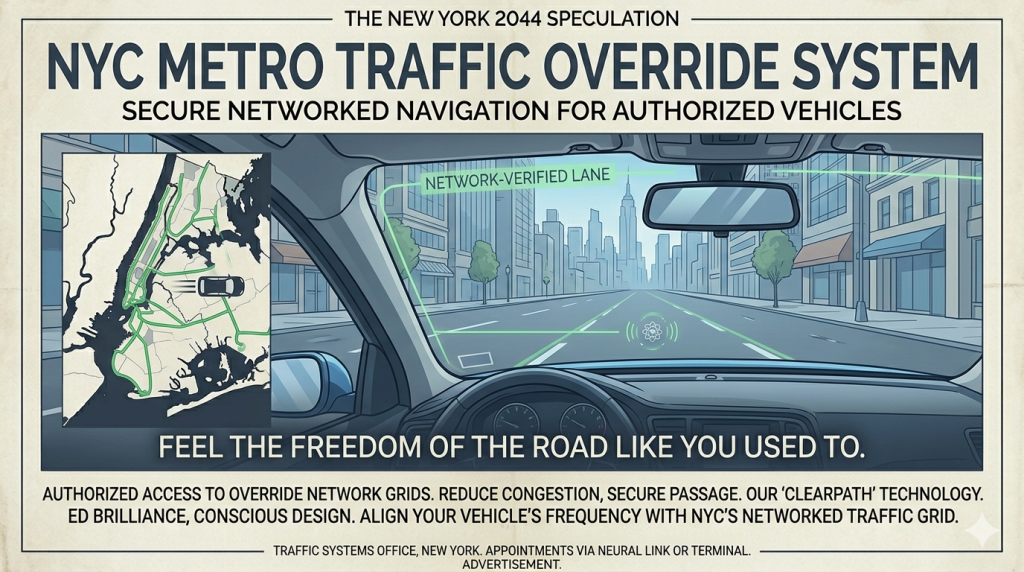
Directly below, the self-driving freight vehicles move in their tight formation — ten-foot gaps between units, a whisper of electric motors. They now make up roughly 40 percent of the BQE’s daily traffic.
The scaffolding shudders slightly as a gust comes off the water.
Delgado lives in Sheepshead Bay, at the southern end of Brooklyn, where he has lived his whole life. He drives the BQE every day — or rather, his car drives it, as his father drove it before him, and his grandfather before that. “I grew up with this road,” he says. “It’s part of me.” He is a member of Local 40 of the Ironworkers union. His father was UAW, building components for the electric vehicle retrofit lines that moved into the old Sunset Park industrial corridor in the 2030s. His brother still works those lines.
He knows what the mayor is proposing. He is not entirely opposed to a new train line. But he is not entirely convinced, either.
“I understand about the train,” he says, carefully. “But I live in Sheepshead Bay. I need the Belt Parkway. I need the BQE. And I think when politicians start to think about putting their names on something new, it goes to their heads and they forget about what we actually need.”
The Mayor’s Gamble
Mayor Alicia Nurse — elected in 2041 on a platform that her campaign called “honest economics for a working class NYC” with aggressive climate adaptation — had been expecting to spend her first term fighting over housing density and school funding. The Lopez deaths changed that.
She stood at a press conference outside Methodist Hospital three days after the accident, the wind off the harbor in her hair.
“The deaths of Marisol and Dario Lopez are tragic for our city — and unnecessary,” she said. “We are finally relocating most of the camp community to emergency housing. It should have happened years ago.” She paused. “We need to understand this moment. I think Robert Moses’s old rustbucket is telling this city something we cannot afford not to hear. We have been reveling in our old glory, unable to make hard choices and sacrifices — and our city is rotting at the core. It is time for building up a city for the future. I think we are ready for it.”
What Nurse is proposing — and what she will need the City Council, the state legislature, and ultimately the public to approve — is a grand bargain of a kind that New York has not attempted since the postwar era. It has four components.
The view from his scaffolding is a study in contrasts: to the west, Manhattan shimmers with green-roofed mid-rises and living rooftops; beyond Governors Island, 140 offshore wind turbines move in slow unison like a white forest growing from the sea.
First, the BQE itself will not be replaced with a new highway. The triple cantilever will be taken down. The corridor will be redeveloped, partly as an extension of Brooklyn Bridge Park, partly as a surface boulevard for local traffic. The highway’s freight and commuter function will be absorbed by a major expansion of the Interborough Express — the light-rail line that has connected Brooklyn and Queens since 2033 — and by an accelerated buildout of freight rail and barge capacity along the Brooklyn waterfront.
Second, the city will issue $14 billion in infrastructure bonds to fund the transition, the IBX expansion, and a parallel program of school construction and rehabilitation across the outer boroughs.
Third — and this is the part that makes people uncomfortable — the bonds will be paid for by raising taxes. The bonds are raised in part by closing a series of tax exemptions that have long shielded mid-level real estate income and small business profits from city taxation, and by a new progressive surcharge on incomes above $350,000.
“We cannot keep expecting billionaires to fix society,” Nurse said at the press conference, her voice even. “It is a pipedream. If we have learned anything from the last thirty years it is that they won’t save us. They are completely uninterested in redistribution, or democracy for that matter. But more importantly — we need people to start seeing taxes as a buy-in opportunity rather than a burden. Successful societies all around the world share the tax burden and enjoy a better quality of life. They do not have thousands of families living under bridges that are falling apart on top of them.”
The fourth component is political education.
“Political education is what this comes down to,” she says. “You can have the right policy. You can have the numbers. You can have the right engineers and economists. But if people don’t understand what they’re being asked to do and why — if they can’t see the connection between what they pay and what they get — then the opposition will eat us alive.”
The Education Problem
The opposition Nurse fears is not primarily ideological. It is emotional and historical. Americans — and New Yorkers in particular — have spent the better part of a century being told that taxes are theft, that government is incompetent, that the private sector does everything better. That story has been told loudly and with considerable skill: in think tank white papers, in tabloid headlines, in the mouths of politicians who understood that the visceral appeal of keeping your money is more immediately compelling than the abstract promise of better public services.
The left, for its part, spent decades substituting moral clarity for political persuasion, optimizing for internal purity rather than external coalition-building, and allowing the argument about taxation to remain a simple binary between soaking the ultra-rich — always popular — and anything broader, which was treated as capitulation.
The Mamdani years changed some of that. The former mayor — who served two terms beginning in 2025, and whose administration is now regarded as something like the foundation on which the current moment was built — was not a transformational figure in the classic sense. He governed in a period of genuine fiscal constraint, delivered modest but real expansions of social services, and maintained the kind of message discipline that made it very difficult for opponents to caricature his administration. He was a Democratic Socialists of America-aligned mayor, and the fact that he left office with approval ratings above sixty percent was, in the telling of many in the current movement, more important than any single policy he passed.
"I understand about the train," he says. "But I live in Sheepshead Bay. It's not going there. How is it going to help me?"
“Winning slowly builds the muscle memory of winning,” says Carmen Vega, 44, the director of the Fiscal Commons Institute — a left-leaning policy organization that grew out of the old Fiscal Policy Institute and has spent the last decade producing the economic research undergirding the Nurse administration’s tax proposals. “For a very long time the left was good at being right and bad at being effective.”
What Vega means, specifically, is this: over the last fifteen years, the coalition that now supports Mayor Nurse has developed something it previously lacked — a capacity to absorb a win and build on it, rather than fracturing over what the win wasn’t. The DSA, which spent the 2020s oscillating between electoral ambition and internal ideological combat, emerged from the Great Storm period as a leaner and more focused organization. The flood produced a shared civic emergency that made factional disputes feel less urgent. The organization shed some of its internet-era habits — the tendency to fight signal wars on social media rather than persuasion battles in community rooms, to treat every compromise as a betrayal rather than a move on a longer board.
“We spent a lot of years being extremely online,” Vega says, not without humor. “And being extremely online is a very good way to feel like you’re winning while you’re losing.”
Marcus Delgado’s union local received a briefing from a Fiscal Commons Institute researcher last week — one of roughly two hundred similar sessions held across the city since January. He was skeptical going in, he says. He is still not fully persuaded.
“She showed us numbers,” he says, setting down his wrench. “Norway, France — places like that. They pay more, they get more. I get it in theory. But you know what they have that we don’t? Their people already believe the government is going to give them something nice. Here, people have been burned. You pay your taxes and the road falls on your neighbor’s kid.” He gestures, with some bitterness, at the scaffolding around him. “So you’ve got a persuasion problem.”
What Comes Next
The City Council is expected to take up the mayor’s infrastructure and tax proposal in April. The state legislature will need to authorize several components, including the income surcharge, which means a fight in Albany that no one expects to be easy.
The IBX expansion study is scheduled for completion in June. A coalition of outer-borough homeowner groups has already announced its opposition to the property tax adjustments embedded in the proposal, and the building trades unions — whose members would build the IBX expansion and the new school buildings — are officially supportive but privately divided over the highway question. Local 40 has not yet taken a position.
On the scaffolding, Marcus Delgado zips his jacket against a gust and looks north toward the Manhattan Bridge. The great wind turbines turn in the middle distance. The self-driving freight trains of cars below him move in their silent, tight formations.
“You know what I keep thinking about?” he says. He does not wait for an answer. “Moses built this thing to last. He built it right here because it was the hardest way to do it, and he did it anyway, and everyone thought it was the most amazing thing they’d ever seen.” He looks at the rusting railing in front of him. “Ninety years. I guess that’s something.” He picks up his wrench. “But it’s time for something new.”