
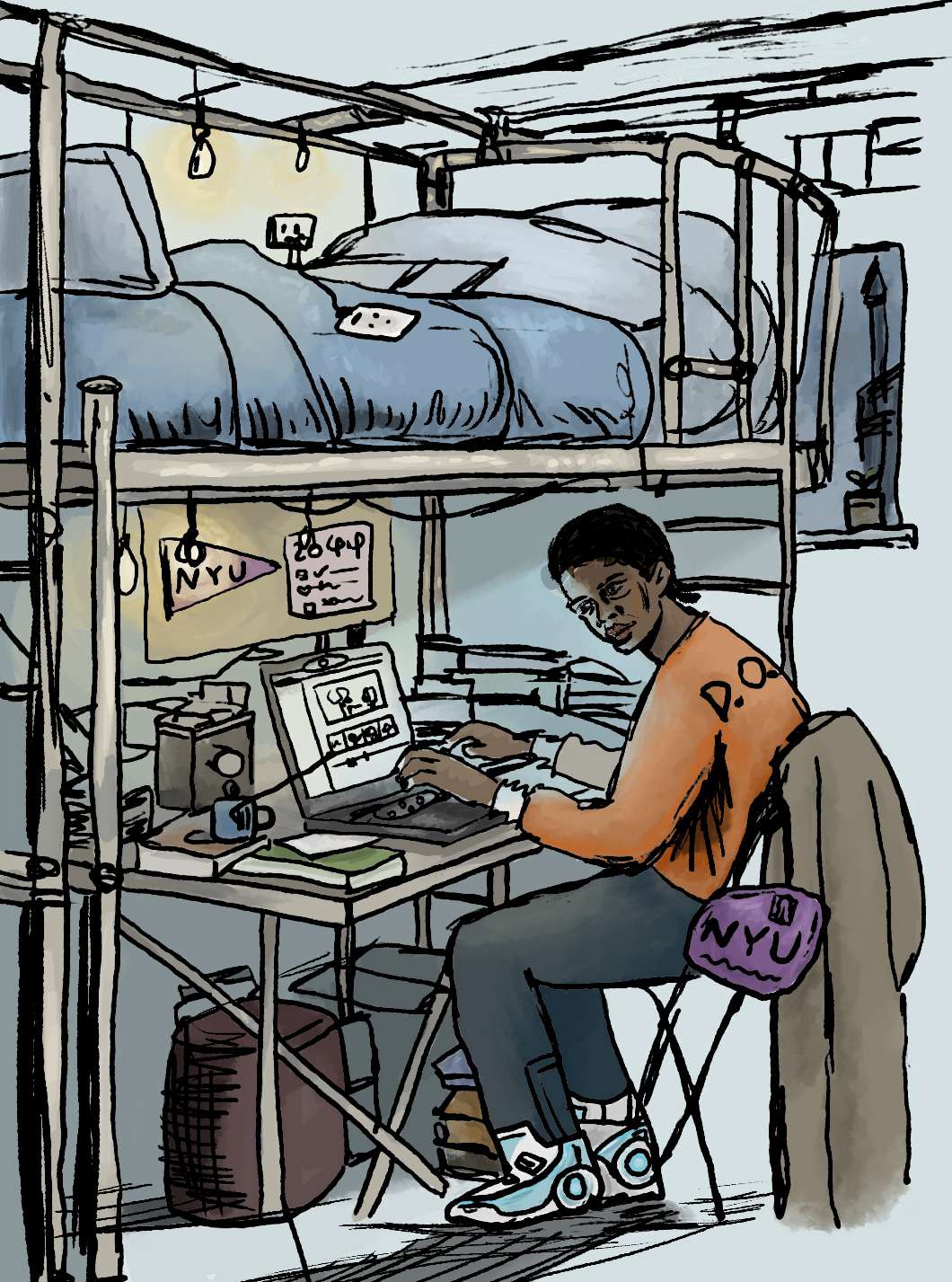
On a Tuesday afternoon in March, Darius Okafor is editing in a borrowed room on the fourth floor of a building in Bushwick. Once a garment factory, the floor became a single artist’s loft, then a co-working space, then a casualty of the 2036 commercial real estate collapse over the years. Today, it’s shared by a dozen young international filmmakers who rotate through on a monthly basis. His rent for the month is $540. His tuition, for the distributed MFA program at NYU Tisch he is completing from New York rather than from his home city of Lagos, is roughly half what it would have been a decade ago.
“I could have made this film in Lagos,” he says, not looking up from his monitor. “I came to New York for the conversations — the creative friction. To be honest though, the city feels a little lower energy than I had expected.”
This spring, NYU Tisch made it official. Most students in the film and fine arts programs would no longer be required to live in New York full-time. Under the distributed studio model, students complete their work in their home cities and travel to New York for short intensives a few times a year. It was also plainly a response to numbers that had become impossible to ignore. Applications to major New York film programs had declined nearly 50 percent over the previous decade. The median rent in Manhattan and much of Brooklyn crossed $9,000 a month in the late 2030s. The all-in annual cost of a Tisch degree had been running well over $150,000 for years — a figure that had begun to function less as a price than as a filter.
“For a long time people believed that if you didn’t move to New York, you couldn’t really become a filmmaker,” says Claudia Ferreira, a curriculum director who helped design the distributed model. “But more recently, it’s been clear that living in New York his more of an expensive tradition than a professional necessity.”

For most of the twentieth century, that tradition was the best path to the summit—at least on the East Coast. The equipment was here. The editors were here. The network that could convert a student film into a career existed in physical space, and that space was expensive and specific. But slowly, and then all at once, the industry stopped being a place. Production dispersed. The holospace replaced the edit suite. Already By 2030, AI-assisted environments and virtual sets were standard. A student in Guadalajara or Accra or suburban Dallas could complete a rigorous film education without relocating, without the debt load that relocation implies, without the survival jobs that once consumed the years supposed to be devoted to craft.
"The gatekeepers are more distributed, but you still have to pass through them."
“The path into cinema no longer begins with a move to Manhattan,” says Ferreira. “It begins with a network.”
She means this as a good thing. Not everyone hears it that way.
Back in Bushwick, Okafor has stopped editing and is eating barbacoa tacos that a drone has delivered to his window. “The industry is much more conservative than it presents itself. You can do the work anywhere, but it’s still about who you know. The gatekeepers are more distributed, but you still have to pass through them.”
Filmmakers who came of age entirely within distributed programs are already producing a recognizable aesthetic — formally precise, technically accomplished, and, in the view of some critics, curiously sealed. The social world appears as backdrop rather than creative pressure.
Margot Venn, who has taught cinematography at a New York institution for nineteen years, describes what she calls the friction problem. “When students genuinely lived here — when they were broke and stressed and sharing apartments and riding the subway at 2 a.m. — they were in contact with the city. They shared space with people whose lives were nothing like theirs. That friction is not comfortable. It is also, historically, where a lot of important films come from. Taxi Driver and Do the Right Thing were both made by Tisch grads who made that sort of contact.”
Filmmakers who came of age entirely within distributed programs are already producing a recognizable aesthetic — formally precise, technically accomplished, and, in the view of some critics, curiously sealed. The social world appears as backdrop rather than creative pressure.
Okafor pushes back. “I grew up in Lagos. I know what friction is. I don’t need New York to provide it.” But he concedes the point. “The people getting the most out of the distributed model are the ones already embedded in something — a community, a scene, a city with its own culture.”
He finishes his lunch and looks out the window at the Bushwick streetscape — delivery drones hovering outside a bodega, a fading hand-painted mural, a security robot glides down the sidewalk. Two floors below, someone is asleep in a doorway.
"The city is still the city," he says. "Filthy, expensive, everyone slightly destabilized, the infrastructure coming apart at the edges. And people still come."
“The city is still the city,” he says. “Filthy, expensive, everyone slightly destabilized, the infrastructure coming apart at the edges. And people still come.” He turns back to his monitor. “That would actually be a very interesting film, if someone wants to make it. What keeps drawing people to a place even when there’s no more reason. Is it the ghosts?”
He goes back to editing. Outside, New York goes on — smaller in some ways than it used to be, still somehow the place where certain conversations happen that do not happen anywhere else. Whether that is enough to justify what it costs to have them is a question the city is still, loudly and expensively, in the middle of answering.