


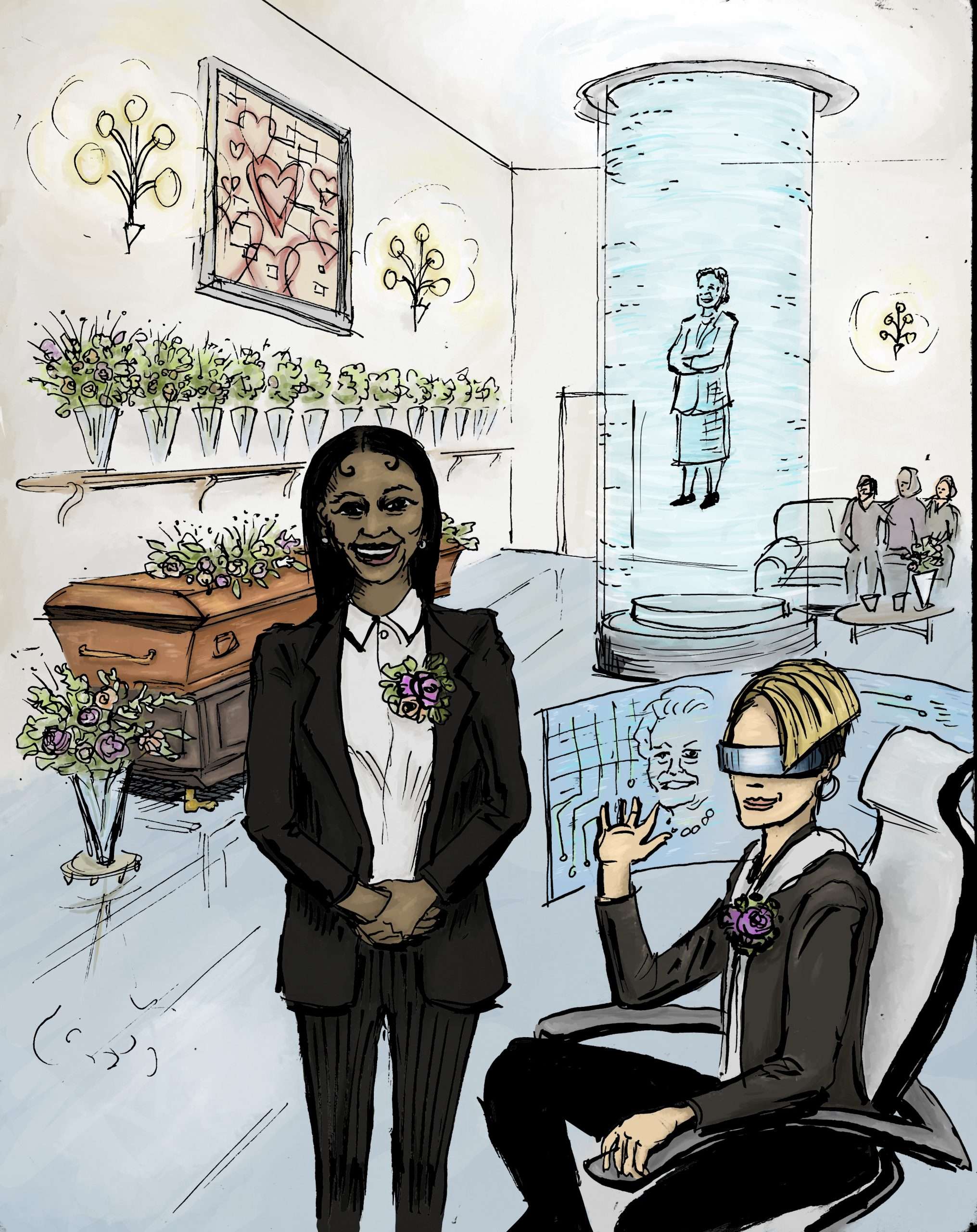
Verdant leaves fan out from an organic landscape built into the lobby wall—something between a terrarium and a living mural. Soothing music moves between speakers, melodic tones melding with the tinkle of miniature waterfalls. On white couches near the entrance, the Vasquez family waits. The parents take turns soothing their tear-stained nine-year-old. Her teenage brother stares into the middle distance, his eyes doing the small rapid flickers that suggest he’s gaming behind a private display.
A polished wood door opens. A woman approaches. The parents rise. “It’s so nice to finally meet you. I’m Angela. Would you like some tea? We have boba for the kids.”
Angela Rios is the co-founder of Death Out of the Shadows, a grief-technology firm headquartered in Carroll Gardens, Brooklyn. Her business, launched in 2039 with her partner Darlin Chu, offers what has become the standard in the grief industry: AI-generated holographic likeness of a recently deceased loved one, lifelike enough in gesture, voice, and memory to hold a conversation, deliver a eulogy, and—for some clients, at an additional monthly fee—take up ongoing residence in a family home. What sets Death Out of the Shadows apart is how this technology is carefully facilitated into the lives of families like the Vasquez.
In a back-room laboratory a few feet from the lobby, a technician and co-founder named Darlin Chu works at a wraparound coding station beside a metallic cylindrical pedestal. An elderly woman rotates slowly above it—hovering, smiling, occasionally raising an arm in greeting. She died eleven days ago. Every few minutes the image stutters, pixelates, and resolves again as Chu reboots a subroutine.
Angela appears in the doorway.
“Can I bring the family in to meet her?”
“Twenty minutes.”
“Perfect. I’ll go over some ethical considerations with them first.”
The woman on the pedestal is Mona Vasquez, 74, who died of a cardiac event at her home in Flushing two weeks ago. The hologram has been trained on roughly four thousand photographs, twenty years of voice messages and video calls recovered from her family’s devices, and sixty pages of written recollections contributed by her children, grandchildren, two surviving sisters, and a neighbor who knew her for thirty years. It knows her speech patterns, such as her habit of adding the phrase “God willing” to any statement about the future.
When Angela returns with the family, she presents the options with a measured warmth: “Mona can appear on a stage to give a loving speech to the assembled guests at the service, or she can move through the room and share personal memories with people one on one. Which feels right to you?”
Mona’s daughter, Carmen, thinks for a moment. “I don’t know yet. But I’ve been thinking a lot about what she should be wearing.”
An elderly woman rotates slowly above it—hovering, smiling, occasionally raising an arm in greeting. She died eleven days ago.
“That’s really important,” Angela affirms. “If you have her clothing preserved, that’s ideal for scanning. Photographs work too.”
She pauses. “There’s something else I’d like to bring up before you meet your mother’s hologram. This can be a profound and even beautiful experience. But there are hidden challenges we need to name. You’ll find her incredibly lifelike—her gestures, her voice. That can make it difficult to maintain your sense of where you are in the loss. The hologram is not your mother. We are here to help you find a balance.”
Death Out of the Shadows
In the last five years, AI grief holograms have become one of the fastest-growing sectors in the American death-care industry, which already generates over $30 billion annually. The technology matured quickly: when large-language models merged with high-fidelity photogrammetric rendering around 2038, the result was lifelike in ways that earlier digital-memorial products—chatbots, “memorial avatars,” video composites—never quite achieved. Funeral homes moved faster than regulatory frameworks.
1 in 6 American families who have lost a loved one since 2040 have used some form of AI hologram grief service, according to the National Funeral Directors Association.
The results, in a number of documented cases, have been disastrous. Elvira König, a specialist in ethical grief studies at CUNY’s School of Public and Urban Policy, has spent three years cataloguing the harms. “We’ve seen a significant spike in what I’d call fantasy trauma—a kind of dissociation from the reality of the loss, where the grieving person can no longer locate themselves in chronological time,” she told me. “They know intellectually that the person is gone. But the hologram keeps short-circuiting that knowing.”
There is also the financial disaster aspect. Hologram services typically begin with a one-time production fee—ranging from $12,000 to upward of $100,000 depending on the provider and the depth of personalization—and are sustained by monthly subscription plans that keep the hologram accessible, updated, and responsive.
König has documented families cutting food budgets and taking on high-interest debt to maintain subscriptions. “It represents one of the fastest-growing sources of consumer debt accumulation we’ve seen in a decade,” she said. “And because the pain is so acute, and the product is so seductive, people’s decision-making is compromised. These decisions are made at the height of grief. That’s a vulnerability that a lot of companies have not been shy about exploiting.”
Death Out of the Shadows doesn’t offer post-funeral subscriptions that incentivize indefinite use. It doesn’t allow clients to activate holograms in private, unsupervised settings during the first ninety days of bereavement. And it is explicit about the psychological risks of extended holographic contact.
“We lose people to providers who will say yes to everything,” Angela told me. “But we take care of our clients. And many clients have already watched someone they love get lost in it, and that’s why they come.”
We've seen a significant spike in what I'd call fantasy trauma—a kind of dissociation from the reality of the loss, where the grieving person can no longer locate themselves in chronological time.
König, for her part, considers Death Out of the Shadows a proof of concept. “They’re demonstrating that ethical guardrails don’t have to be bad for business. In fact, they strengthen trust in a brand. Their success shows you don’t have to exploit grief to profit from it.”
Education: Two Paths Through CUNY
Angela Rios studied under König, completing a four-year bachelor’s degree in philosophy at Hunter College, followed by a graduate degree in grief ethics at CUNY’s School of Public and Urban Policy—one of only a handful of such programs in the country. The field, barely a discipline ten years ago, now encompasses courses in bereavement psychology, technology law, digital identity after death, and the philosophy of memory and personhood.
CUNY matched her with Darlin Chu through a new entrepreneurial-pairing initiative. Darlin came through a different track entirely: the Highspeed TrainUp program, which allows students to pursue professional credentials in as little as a month. Darlin was always excited by technology, and she always knew she wanted to be an entrepreneur. She chose credentials that allowed her to build specific skills while developing the concept of her first business.
She holds twelve of them, ranging from AI personality modeling to holographic group facilitation. She is, in the terminology of her field, a master practitioner rather than a theorist—and she is the reason the holograms at Death Out of the Shadows work as well as they do.
Their pairing reflects a broader shift at CUNY. Today, only about 50% of CUNY students complete traditional four-year or two-year degrees. Many students seek out shorter credential pathways, particularly in technical fields tied to the domestic manufacturing boom in renewable infrastructure and robotics. Credentialed workers in fields like AI facilitation, advanced energy systems, and precision installation often out-earn their degree-holding peers.
The split did not happen cleanly. At first, the credential tracks drew students disproportionately from lower-income families, while the bachelor’s programs continued to enroll students from middle and higher-income families, who could afford to invest in a traditional college experience and delay entering the workforce—a pattern familiar enough that researchers had a term for it: the open-access paradox, where the institution that promises the most access quietly sorts its students before they know they’re being sorted. As the fields of white-collar jobs that require traditional bachelor’s degrees have changed in the past two decades, these enrollment patterns have become less predictable, with more students from middle-class families bypassing traditional degrees in favor of stackable credentials. The greater challenge has been keeping paths to traditional degrees appealing to students from all backgrounds.
“Longer study often translates to lower pay—at least in the short term,” König told me, with a mix of candor and rue. “The humanities haven’t solved that. What we try to do is make the case that ethical reasoning has market value, as well as intrinsic value. Angela and Darlin are that case.”
The pairing was brokered in part by Cousin Lew, CUNY’s AI advising and matching system, which analyzes student skillsets, personality profiles, and entrepreneurial aptitude to identify potential business partners before graduation. The system grew out of a simpler ambition: automating the drudgery of course scheduling so that human advisors could spend less time finding students a statistics class that fits on Tuesday morning, and more time asking whether they were eating, sleeping, and actually thriving. That it evolved into a business-pairing engine is either a sign of how far the technology traveled, or of how thoroughly the market colonized the logic of care—depending on whom you ask. “At CUNY, we try to match people with skills that won’t just succeed in the market, but lead the way forward,” says Cousin Lew.
What neither of them says, though it is legible in the arc of their story, is how much depended on the specific choices each made at a specific moment—and on having enough of the right kind of slack to make those choices at all. Angela’s path through a bachelor’s and master’s degree required her family’s faith and support while she lived at home and studied full-time, working only part-time and during some summers. Darlin’s credential sprint required a different kind of faith: that twelve badges would add up to something, that the stack of credentials would hold. CUNY has always supported these two kinds of wagers, and at times struggled with the tension between them.
What the Basement Taught Her
Angela was one year old when her parents arrived from Venezuela, during the years of political collapse that emptied so much of that country through the 2020s. The family settled in Queens, where an uncle had connections. For several years during the Trump administration’s second term, they lived in the basement of a friend’s house in Corona, avoiding the roving ICE sweeps that became a constant feature of immigrant life in New York during that period.
It hollowed out my mother's heart. Now, people can take their time to say goodbye. That would have meant everything to my mother. But we also make sure that the long goodbye doesn't create new forms of suffering.
One of Angela’s earliest memories is of her grandmother’s death, when Angela was five. There was no funeral to attend, no flight back to Caracas to arrange. Her mother grieved quietly in their basement—a loss in hiding.
“It hollowed out my mother’s heart,” Angela told me. “I don’t know if she’s recovered.”
She sat with this for a moment.
“What my mom experienced was so deeply unfair—it was just wrong, and it stayed with me all my childhood. Why was she denied this basic human need to grieve just because of her passport? That disconnect led me to all sorts of questions about morality, ethics, the edges of life—and eventually, I went for a philosophy degree at CUNY.”
“Now, people can take their time to say goodbye. That would have meant everything to my mother. But at Death Out of the Shadows, we also make sure that the long goodbye doesn’t create new forms of suffering.”
Angela and Darlin are both homeowners in Brooklyn now. Angela’s mother lives in the apartment upstairs, in a unit with south-facing windows where she can watch the sky. They had an elevator installed to make the stairs manageable as she ages.
Angela was never going to put her mother in the basement. And the road from that basement to this apartment ran, in no small part, through a university that was built on the premise that higher education should be open to everyone who seeks it, and no one in this city should be permanently out of the game.
In 2044, we are still at a distance from fully realizing the fullness of that premise. And yet, hundreds of thousands of graduates are charting innovative pathways through college and into careers that answer timeless problems with new technologies and impressive amounts of energy and soul.
From the Archive
For the Grieving, and Other Consumers
Between 1910 and 1950, the American funeral industry underwent a sustained commercial transformation in which undertakers repositioned themselves as 'funeral directors' offering increasingly elaborate and expensive services to families at their most vulnerable. The Federal Trade Commission began receiving complaints about predatory pricing and high-pressure sales tactics as early as the 1950s, culminating in a formal rulemaking process that produced the FTC Funeral Rule of 1984, which required funeral providers to itemise costs and prohibited them from exploiting consumers' emotional state to sell unnecessary services.
Will the F.T.C. now act on other overdue consumer protections? Will Congress allow it?
There's often room for principled disagreement about consumer protection rules, but not on the issue of funerals. When survivors must suddenly buy them, few know what choices exist or even what questions to ask. Who, in grief, is in a mood to shop around? As the F.T.C. learned, consumers are frequently gulled or shamed into paying for services they neither need nor want.
Morticians will now have to provide detailed price lists on first contact, by phone if asked. They must inform consumers that embalming is not usually required by law and they may not insist on selling caskets for cremations.
These are not burdensome rules. Yet they were bitterly resisted. A somewhat tougher code, approved in 1979, was turned back by Congress. The revised rules barely survived a Congressional veto in 1982, and only this month cleared the courts.
Advertisement
SKIP ADVERTISEMENT
The reason for these delays was the well-funded opposition of the funeral industry. And its show of strength has inspired other industries to attack the commission through Congress. That became reason enough for the commission's new conservative majority to water down or delay other actions. Consumer rules should not be promulgated lightly. But conservatives and liberals ought to be able to agree that certain disclosures and prohibitions not only protect buyers but also improve business efficiency. For example, if used car dealers are made to disclose already known defects, consumers don't have to pay for reinspections. Or take the sales of hearing aids to usually elderly, embarrassed customers. These should not be final until customers have a proper chance to try out the devices. Some opticians, on the other hand, need relief from states that deny them stores in shopping centers. Other pending proposals would prevent certain industries, like building materials and electrical equipment, from manipulating codes and standards to bar competing technologies. Even if the F.T.C. bestirs itself in these areas, Congress may override its decisions. But that at least would squarely fix the responsibility for inaction. Morticians and used car dealers may pay for Congressional election campaigns, but it's still consumers who vote.