


It’s September in New York City. The parks are green, and the air is crisp — crisp enough to make the offshore wind turbines spin in steady arcs off the Rockaways. The impending presidential election is in the air too, a ritual with a new sense of urgency ever since voting restarted eight years ago.
It’s been many years now that the Regents exams, once a prerequisite for the cap and the gown, were replaced by a non-test assessment called Portrait of a Graduate. But in this election year, some POG portfolios are taking on a new dimension, particularly when it comes to civic engagement.
Critics call for a return to the Regents, pointing to math scores declining in international rankings. POG supporters counter that students need to be assessed as activated citizens — especially following CUNY’s massive shift toward technical micro-credentialing. If the skills of an active citizen haven’t been built by the end of high school, they say, they may never be.
To better understand how POGs work in 2044, we follow Alma Ibrahim through her school day. Ibrahim attends Green Rising School in the Brooklyn Marine Terminal complex in Red Hook — an unscreened K-12 school specializing in sustainable food and media production, with just over 2,000 students. Alma is among its first class of seniors. She wears a light purple hijab, loves basketball, is obsessed with long-form video, and her favorite author is Octavia Butler.
6:30 AM
Alma’s analog alarm rings. She warms pita and labneh for her two younger brothers, walks them to school, and jumps on the R, her sidepack hanging at her hip.

7:25 AM
"The train is my own time," she tells us, sliding on her silver glasses to watch student-made DeepDive documentaries. "I can't wait to make my own."
“The train is my own time,” she tells us, sliding on her silver glasses to watch student-made DeepDive documentaries. “I can’t wait to make my own.”
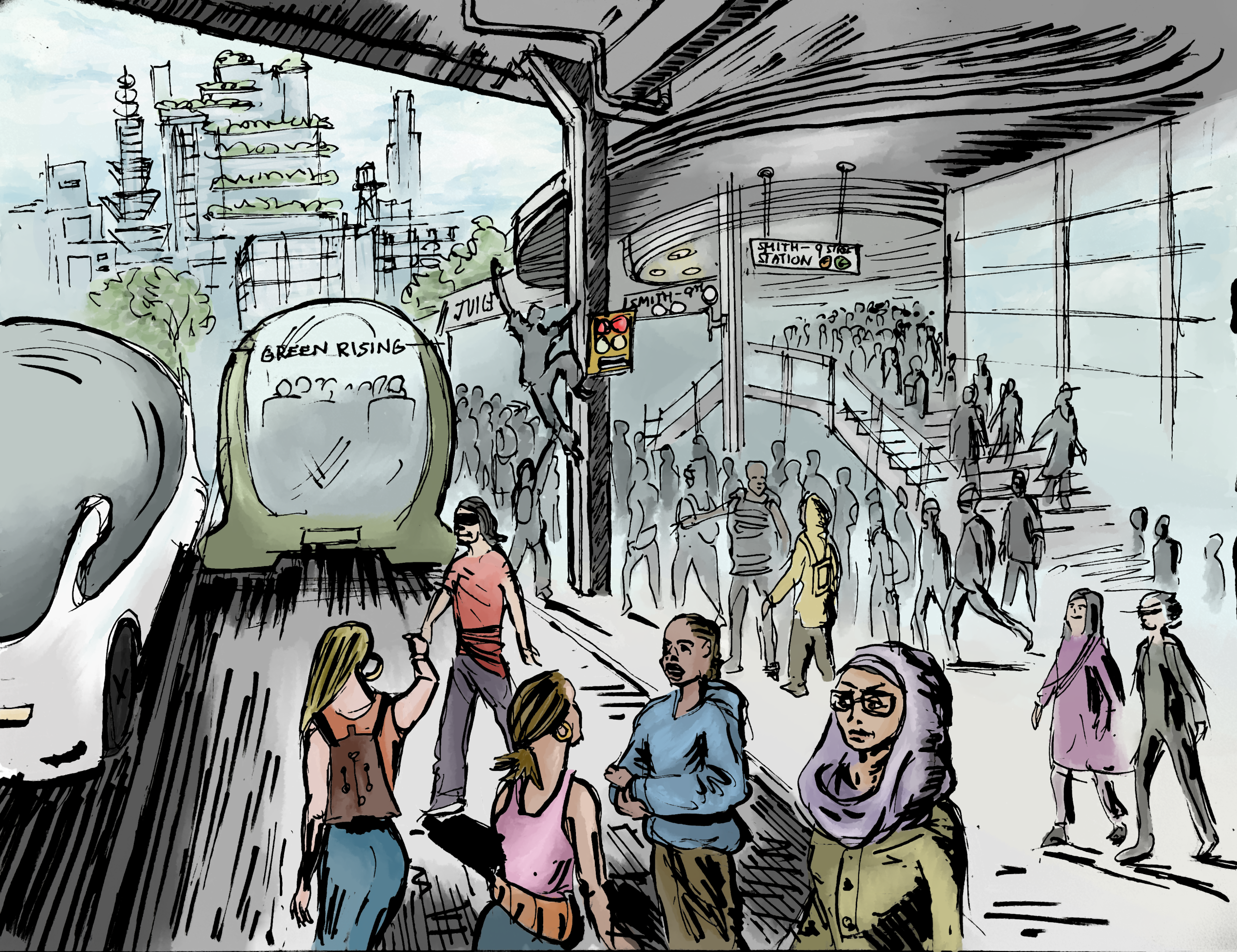
At Smith-9th Street, she joins the flowing mass pouring into shuttles toward the BMT complex. There’s pushing and shouting. “There’s a fight about once a week,” says Alma. “It’s ridiculous.” With the rail extension still on hold, transit has been an issue since the complex opened.
The BMT was conceived with 6,000 living units and a redevelopment of the industrial waterfront. With Atlantic Yards — which failed to deliver its promised housing for decades — looming as a cautionary tale, BMT overdelivered. Today, there are nearly 9,000 units, more than half affordable.
8:00 AM — Period 1
The classroom is light and airy — south-facing windows, poured concrete floors, moveable wooden tables. A whiteboard is half-covered in handwritten voter turnout statistics. There are 25 students and, like most city classrooms, two teachers — the AI layoffs of the 2030s having pushed many careers toward work that still required a human in the room.
“Today is the day many of you have been waiting for,” announces Ms. Rexroth. Partners will be matched city-wide through DOE Grow by language and interests. Half the seniors will travel to their partner’s school; the rest stay. In the afternoon, journalists arrive.
The AI layoffs of the 2030s having pushed many careers toward work that still required a human in the room.
Before she’s finished the sentence, silver, gold, black, and purple glasses are grabbed from sidepacks. The room goes silent, then erupts.
9:36 AM — Period 3
On the roof, students pull on gloves. Green Rising’s three acres of farmable rooftop — kale, chard, tomatoes, summer squash, and a small plot of rice just turning golden — stretch toward a clear view of the harbor and the wind turbines offshore. “Freshman year, I hated this,” says Alma, hauling tomatoes. “Now I feel like this place is ours.”
11:12 AM — Lunch
The cafeteria serves soup and salad from the morning’s harvest. A boy in a large white hoodie walks up and shakes Alma’s hand. She offers him a tomato. He accepts with “Nice!” His name is Daniel, from West Queens Vision Academy, making videos since he was ten. Within ninety seconds, they’ve divided responsibilities: he shoots, she interviews.
12:48 PM — Periods 7–9
"The interview is not the hard part," she tells them. "The hard part is figuring out what your story actually is after forty conversations that all seem to contradict each other."
In the double-height workshop, Amy Zimmer from Chalkbeat steps forward to address the room, giving tips before the students fan out to talk with locals for their own DeepDive documentaries seeking to understand the underlying dynamics of New Yorkers’ presidential votes. “The interview is not the hard part,” she tells them. “The hard part is figuring out what your story actually is after forty conversations that all seem to contradict each other.”
Later, the library partner, Mr. Bernstein, asks: “What is good information?” He lets the silence sit.
In the tech lab, students handle the holographic AR cameras for the first time. “I’ve been waiting to get my hands on these for years,” says Daniel.
As the bell rings, Alma and Daniel walk out together into the afternoon light.
“Let me show you the best snacks around here,” says Alma.