




Leilani Reyes pushes her cart through Home Depot, past stacks of raw and refurbished brick, spools of reclaimed electrical wire, and assorted rusting hardware in need of a wire brush. The air in the store is pleasantly cool. She stops to ask for directions to the garden section.
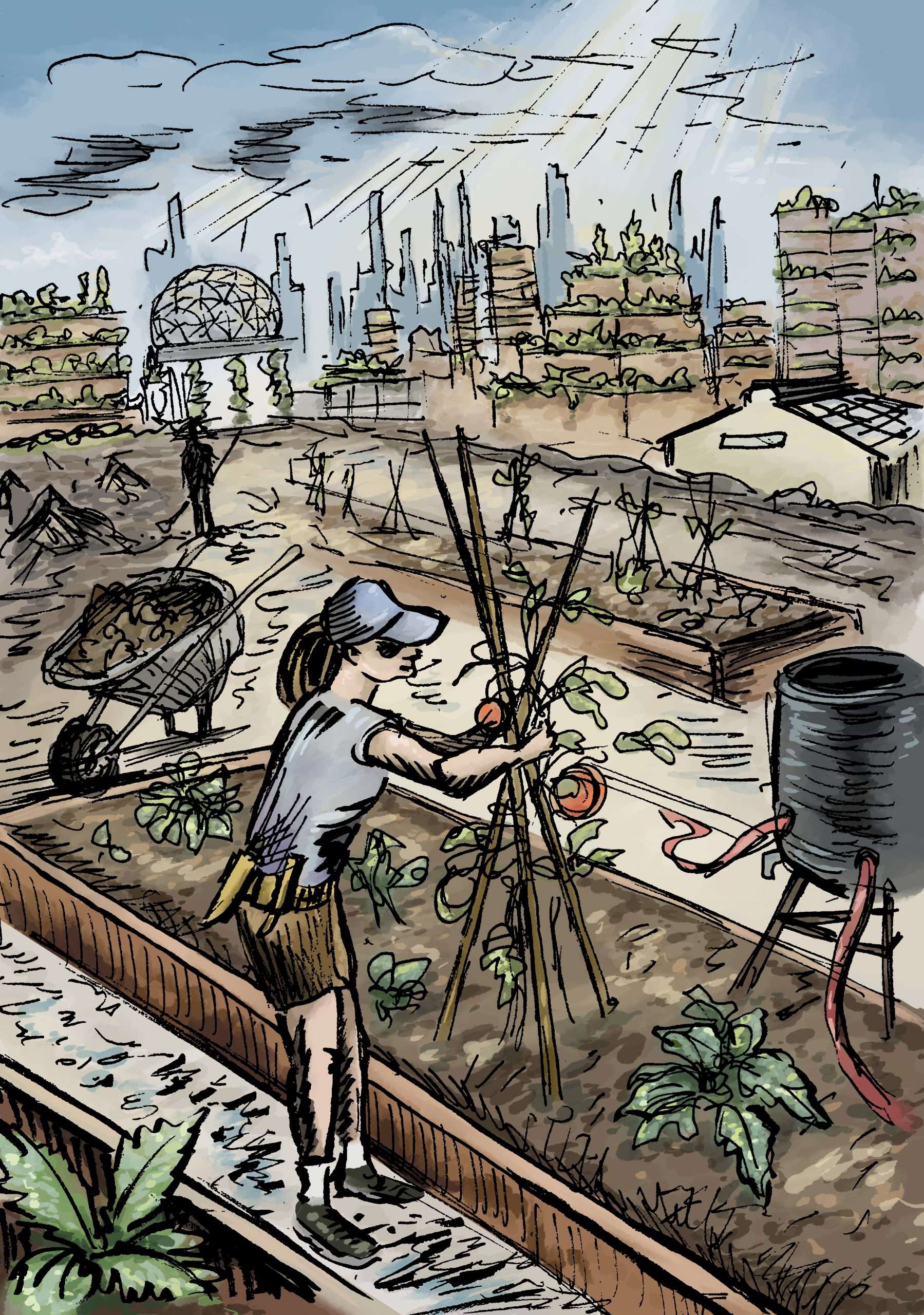
About twenty feet overhead, Lia Mizuno is harvesting eggplants into a large basket. The produce rafts can be seen over Lia’s shoulder, as they float down the Gowanus Canal. Elsewhere on the enormous green roof, birds nest, and bees pollinate purple Borage flowers. The garden keeps the store naturally cave-like and cool, even in the recent wet bulb heat.
Another farmer working alongside Lia is pounding stakes into the ground and tying them to fruit trees—propping them up after they were nearly toppled over in the recent rainfall event. Minor damage from last week’s torrential rain was widespread, with many repairs warranted. Fortunately, just a few people were hurt in the floods, and no one was seriously injured. With the introduction of the Making Space for Neighbors Law, New Yorkers in low areas who have been displaced (there are a few hundred) will be relocated to higher ground.
The Home Depot roof absorbed lots of water, and the remaining runoff was channeled into gardens and green pavement that helped prevent city culverts from being overwhelmed. But 12 years ago, a very different story played out on this same roof. The Great Flood of 2032, remnants of Hurricane Arthur, dropped 12 inches of rain on the city. That spelled catastrophe.
“It was as if the sky were pouring a pot of water down,” recalls Lia. “Cars were swept away. At the time, they were still doing metal roofs. This giant Home Depot roof that I’m standing on—it generated an instant local flood, Gowanus Canal overflowed, and all those people died in basements.”
“And it stunk,” recalled Lia. “When the sewer system is overwhelmed with the volume of rainwater, the raw sewage mixed with the stormwater discharges untreated into the canal —it’s the same system, really, and that takes extra remediation.”
"It was as if the sky were pouring a pot of water down," recalls Lia. "Cars were swept away. At the time, they were still doing metal roofs. This giant Home Depot roof that I'm standing on—it generated an instant local flood, Gowanus Canal overflowed, and all those people died in basements."
The city was ravaged by the flood—hundreds of thousands of New Yorkers fled. “The earth was communicating to us,” says Lia. “Not too gently, but that’s how it goes–we hadn’t been listening. Where else on the planet are we supposed to go? Many of us got to work rebuilding after that, and we knew that this time, it had to be a living city.”
The green roof went up on the Home Depot Building in 2035. By that time, the big investors behind Home Depot pulled out. It was bought by the city and transitioned into the recycled materials coop it is today. The roof was reengineered to hold up to 12 inches of soil.
The vision of a green city has been around for generations, and it was becoming popular ten years before the ’32 storm. Back then, President Biden’s federal government was funding it. It didn’t look like it would take a catastrophe on the scale of Arthur to green NYC. But then the MAGA regime came into power. That was a major setback.
“Trump ripping out the Rose Garden was a bad moment,” says Lia. “He replaced the grass and rose bushes with stone and cement and that god-awful faux-Greek fountain of himself. Millions of Americans followed suit, and green infrastructure all across the US was paved over with concrete, masonry, and other hard surfaces. That was dangerous.”
“When Arthur hit, we knew a change was needed— but we had a problem,” explains Lia. “The funds just weren’t there to build the green infrastructure that could absorb the runoff water into plants. “We would have been stuck, if not for the Water Law.”
"I know it sounds like a boring and minuscule detail—deep in the weeds if you pardon the pun." Mizuno sighs. "But that detail has changed the color of New York City—from grey to green."
Representing a radical overhaul of how cities handle water, lawmakers quickly enacted the Water Law post-Arthur, which switched the payment system for water. Previously, New Yorkers had paid for water, drinking, waste, and stormwater based on portable water usage. The cost for wastewater and stormwater management was a uniform percentage (159% of the portable water usage fee) for all property types. This 159% tacked onto the cost of running tap water generated the money the city needed to invest in stormwater and wastewater systems and green infrastructure like green roofs.
Under the old billing system, massive commercial buildings like Home Depot only paid the city based on potable water usage, so if they had a giant metal roof and parking lot, but just a few bathrooms, they paid very little for runoff management–sending tons of stormwater runoff into city sewers without penalty. But the Water Law separates out the cost of runoff management from the tap water usage.
“I know it sounds like a boring and minuscule detail—deep in the weeds if you pardon the pun.” Mizuno sighs. “But that detail has changed the color of New York City—from grey to green.”
Now, the city receives fees for stormwater management that it can offer back to communities with grants for low-income buildings to green their sidewalks and roofs. Lots of sidewalks have become permeable pavement, and hard-topped backyards have become gardens from the Bronx to Staten Island.
The greening happened just as the container ship attacks began, permanently disrupting the supply chain. Now, ten percent of food consumed in New York households and restaurants is grown in New York City backyards, roofs, and vertical gardens.
About twenty feet overhead, Lia Mizuno is harvesting eggplants into a large basket. The produce rafts can be seen over Lia's shoulder, as they float down the Gowanus Canal.
At Home Depot, Leilani Reyes arrives at the section she’s looking for—DIY green balcony kits. She’s been wanting to do this for a long time in her rental, but her schedule and parenting duties prevent it. Now that she’s on summer break from teaching and has received a rent credit from the city for the vertical garden, she’s ready to get to work.
While paying for her kit, Leilani spots a poster:
Free Gardening Class—Taught by Seasoned Farmer Mizuno.”
Lia signs up, unaware that the farmer is harvesting right over her head.