

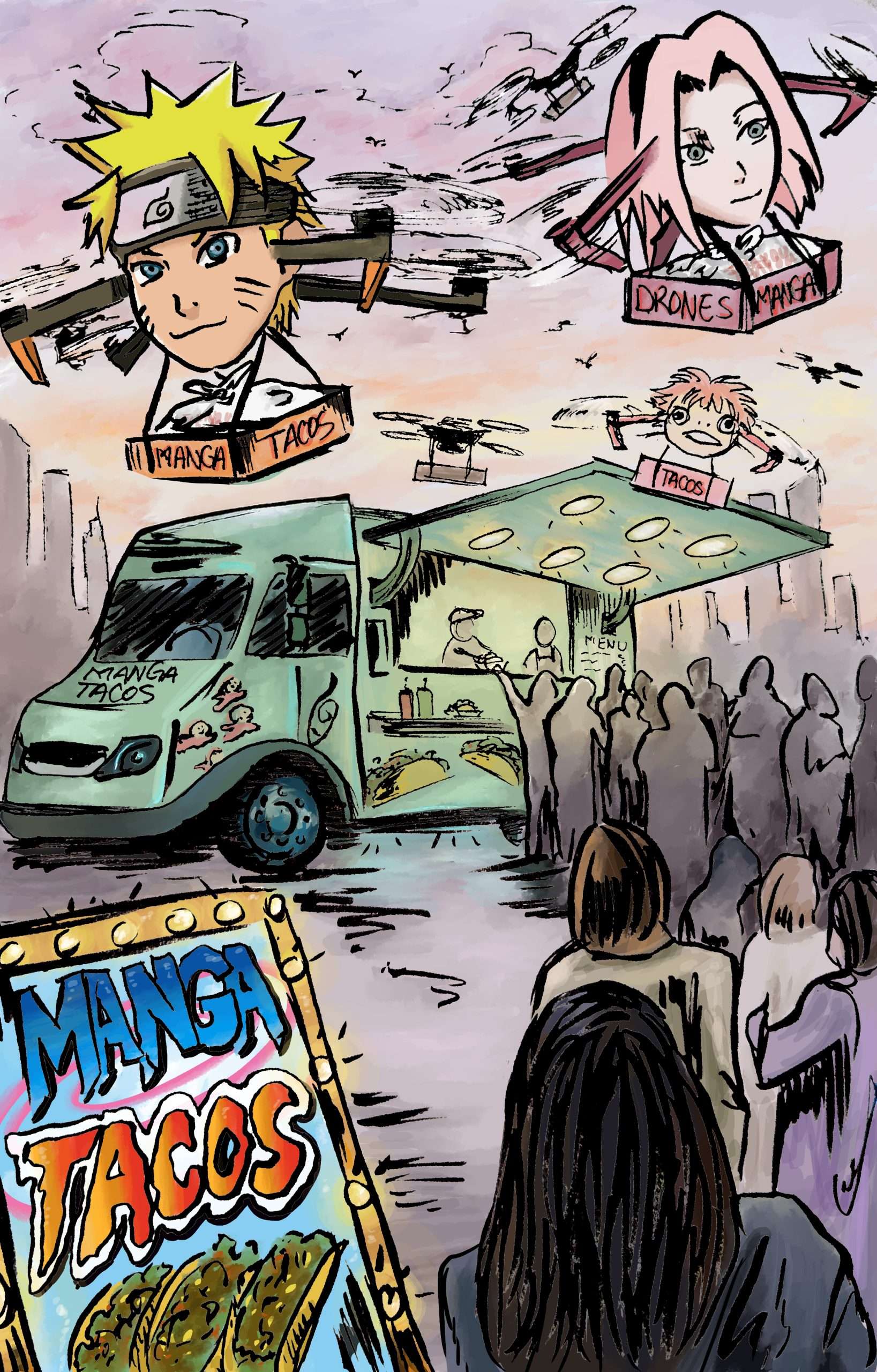
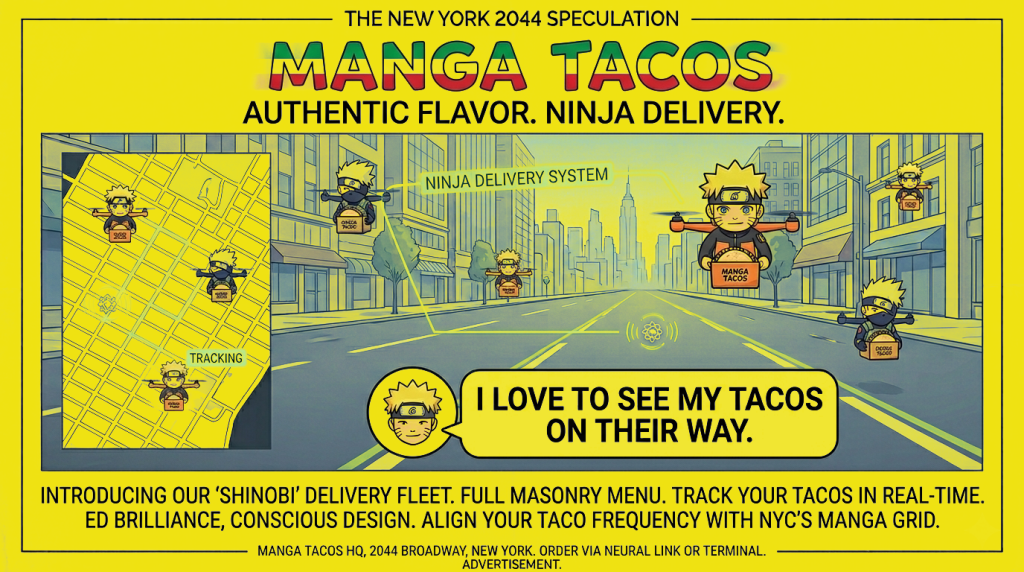
It’s one of those wondrous New York sunsets—rusty orange clouds toward the west. High above the city, dots glint in the presence of drones. We zoom our glasses in, and it’s manga characters passing through the spires of supertalls. Naruto is there, so is Sakura, and so is Ponyo. They are all holding the precious cargo: Tacos.
We watch them navigate over green roofs and the manicured sidewalks of Park Slope, descending into the private gardens of the rich. Across the city, more Narutos maneuver past abandoned supertalls into low-income neighborhoods in the outer boroughs. Lots of delivery drones fly these days, but this is the first manga fleet. We decided to follow the Narutos back to their source.
They lead you to one of twelve food trucks operated by entrepreneur Armando Chilaca—each painted in colorful manga imagery, fitted with a drone landing pad on the roof. The drones depart and lift off every few minutes like a wasp colony smelling of succulent grilled meats—if the wasps were anime.
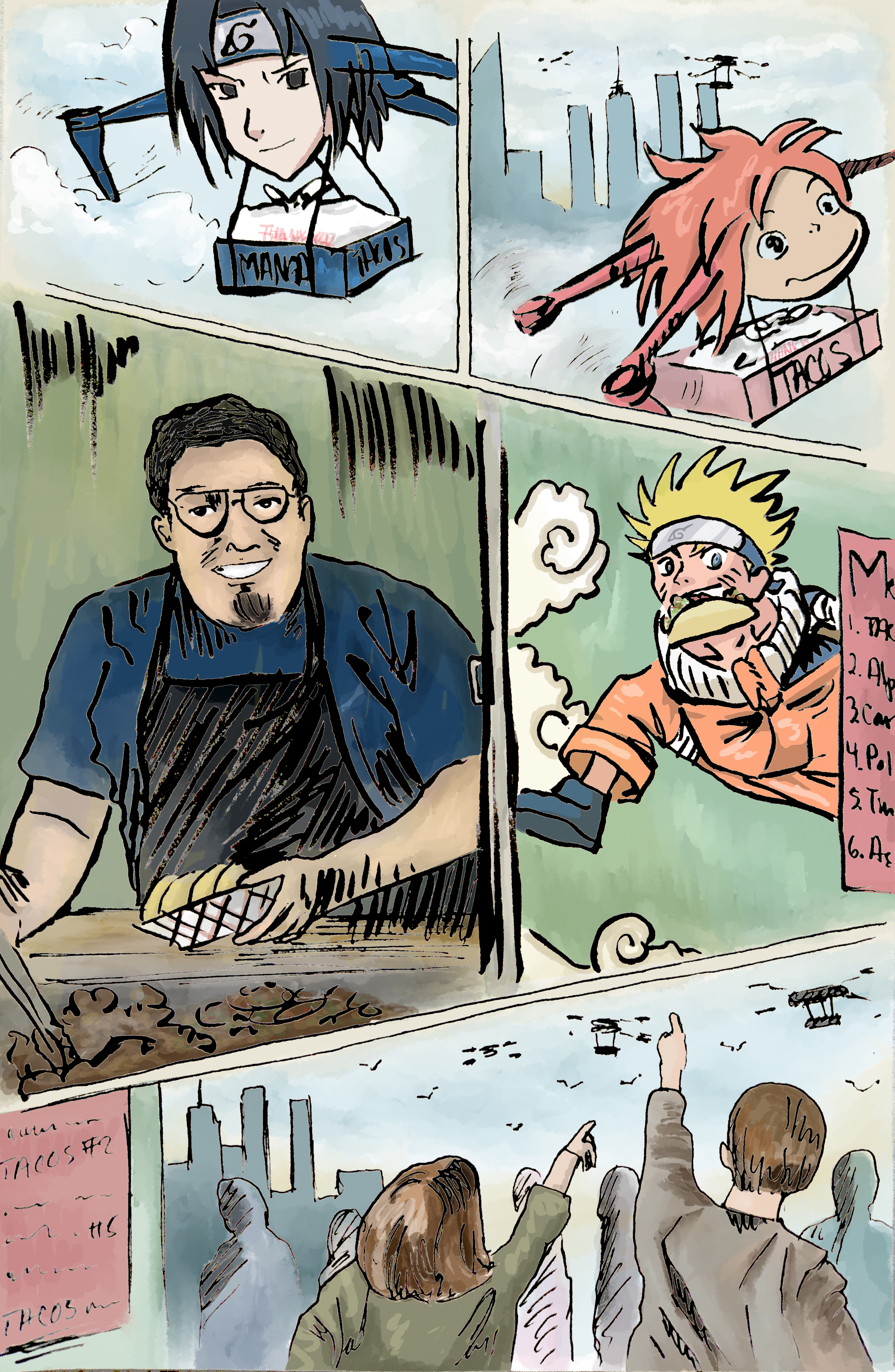
“You only live once,” Armando says with a smile. He makes them old school—greasy and delicious as his grandparents taught him. Lengua and nopales are his favorites. The secret: searing the filling at very high heat in oil with a special spice blend, paired with ultra-fresh cilantro, a squeeze of lemon, and Tajín.
The drones depart and lift off every few minutes like a wasp colony smelling of succulent grilled meats—if the wasps were anime.
At 23, he grew up running around the NYC restaurants where his parents cooked. He is a third-generation New Yorker—the first to launch his own business, and the first to go to college. He wouldn’t have started Manga Tacos if not for the CUNY entrepreneur camp. But he almost didn’t make it.
“CUNY was low-cost, but time was money. High rents were eating our family alive.” Around graduation, his parents sold up and moved to Pennsylvania. Armando stayed for his girlfriend—now his wife—paying too much for a tiny room in Bay Ridge, working to cover his own costs and help his father, who has a physical disability and can’t cook anymore.
At CUNY, he encountered the Immigrant Student Center for Resources and Research at City College, which helped him redesign his life to make space for school. Financial aid waived the tuition.
“I was cooking, working as a trainer on the Upper West Side, and taking classes online during my commutes. I’d jump into VR seminars and set timers to get off at the right stop. My brain was fried.” But he thought about his grandparents and parents—the economy always taking from them, never giving. He needed an edge.
We zoom our glasses in and it's manga characters passing through the spires of supertalls. Naruto is there, so is Sakura, and so is Ponyo. They are all holding the precious cargo: Tacos.
After a year of math, tech, and business strategy, he qualified for the bootcamp: twenty students in a converted Harlem warehouse, high energy, not enough sleep. “We had to launch a complete business in two weeks.” He was paired with Ibrahim, now his silent business partner. The whole concept, marketing, and funding came together in that fortnight.
“The Manga thing came to me on the last day. My abuelitos used to watch Naruto with me when I was small—it was how they learned English. When I thought about what I wanted my brand to feel like, it just made sense.”
Manga Tacos is built on three generations. His grandparents came to the US in the 1990s without papers, working as dishwashers when Mexicans largely made up the city’s underclass. They remember the days of “the Mexican Hunt” as they exited subway stations with their paychecks. They were mugged multiple times. Two of their children were DACA recipients. One—Armando’s mom was born in the US. His grandparents eventually moved back to Mexico. “They live well down there. Sometimes I want to send a taco all the way down there.”
"CUNY was low cost—but time was money. High rents were eating our family alive."
The business almost didn’t survive its first week—three tacos dropped from altitude, one nearly hitting a sunbather in Prospect Park, another splatting over a holo camera at a press event. The photographer sued for millions. Armando called his local representative, who reached the governor, a Mexican American, like many in New York’s political class since the 2030s. “They had my back.” The lawsuit flipped, the case vendor was found liable, and the settlement carried Manga Tacos through a bumpy first year.
“I wanted my customers to enjoy authentic, delicious tacos like my grandparents make, delivered by my favorite manga characters,” he says. “We built that whole enterprise in two weeks at CUNY.”
And with a smile, he hands me my order.