

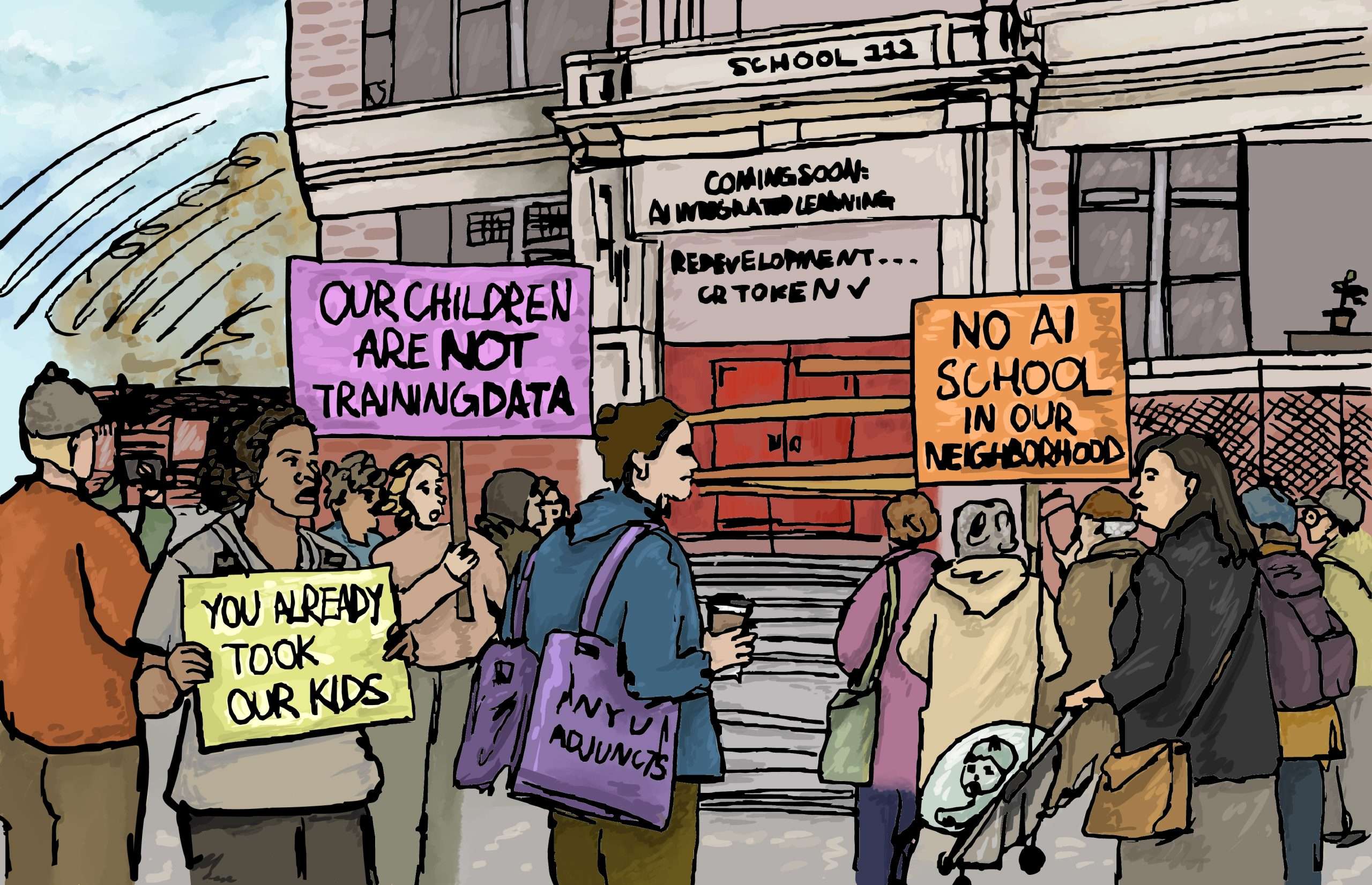
The scene is one New Yorkers know well, even when the issue changes: a crowd gathering outside a public building that has suddenly become more than just a physical space. Parents with strollers slow down to read the signs. Adjunct instructors arrive carrying iced coffee and canvas tote bags, as if they have been pulled into history on the way somewhere else. Older tenants stand slightly apart, watching with the patience of people who have seen many versions of reform arrive on their block before.
The signs belong to the same protest, though they do not all tell the same story. One says OUR CHILDREN ARE NOT TRAINING DATA. Another warns NOT IN OUR NEIGHBORHOOD. A third, painted by hand and held chest-high by a woman in hospital scrubs, says YOU ALREADY TOOK OUR KIDS.
The building stands on East 98th Street, in one of those narrow Manhattan corridors where educational worlds press up against one another without quite touching. A few streets away are private schools with expansive arts programs, small seminars, and families already planning tutors and admissions strategies years in advance. Nearby are neighborhoods that have spent years receiving each new educational experiment in the language of access, equity, modernization, and support.
The building itself had already lived several New York lives. It began as a public school. During the flood-related displacement of the 2030s, it was repurposed as a temporary relocation site for students from another damaged campus. Later, it sat mostly empty, one more institutional shell waiting for a new rationale. In spring 2044, the city announced what that rationale would be: the building would reopen as a new AI-integrated secondary school, part of the latest expansion of New York’s Educational Futures Integration Initiative, first introduced in 2030.
On paper, the program sounded familiar by now. Students would receive adaptive instruction, behavioral support, comprehensive cognitive assessment, workforce-readiness planning, and what officials described as a real chance at success. Administrators would gain efficiency. Teachers would get relief. Families in under-resourced neighborhoods would finally secure the stability they had long been promised.
By 2044, those promises had acquired a history.
"He got really good at saying what they wanted to hear," she said. "But he wasn't growing. He was getting flatter."
Over the past fourteen years, New York expanded AI schooling through a public system already strained by underfunding, staff shortages, and widening inequality. Schools short on money and time received software, monitoring platforms, predictive tools, and state-backed infrastructure. Families heard promises of support. Administrators heard promises of efficiency. What spread through the system was not only new technology, but a new way of reading children: through behavior scores, engagement metrics, cognitive assessments, and the student currency framework known as CR tokens.
Tiana Brooks was one of the parents who once believed. A Black mother who lives near the protest site and works irregular shifts in hospital reception and administrative support, she enrolled her son Malik in one of the city’s early AI-integrated programs and trusted its judgments. When his behavior scores came back low, she read them as confirmation that he needed firmer correction.
“That part is hard to say out loud,” she said. “Because it wasn’t just that they lied to me. It’s what I used their language on my own kid.”
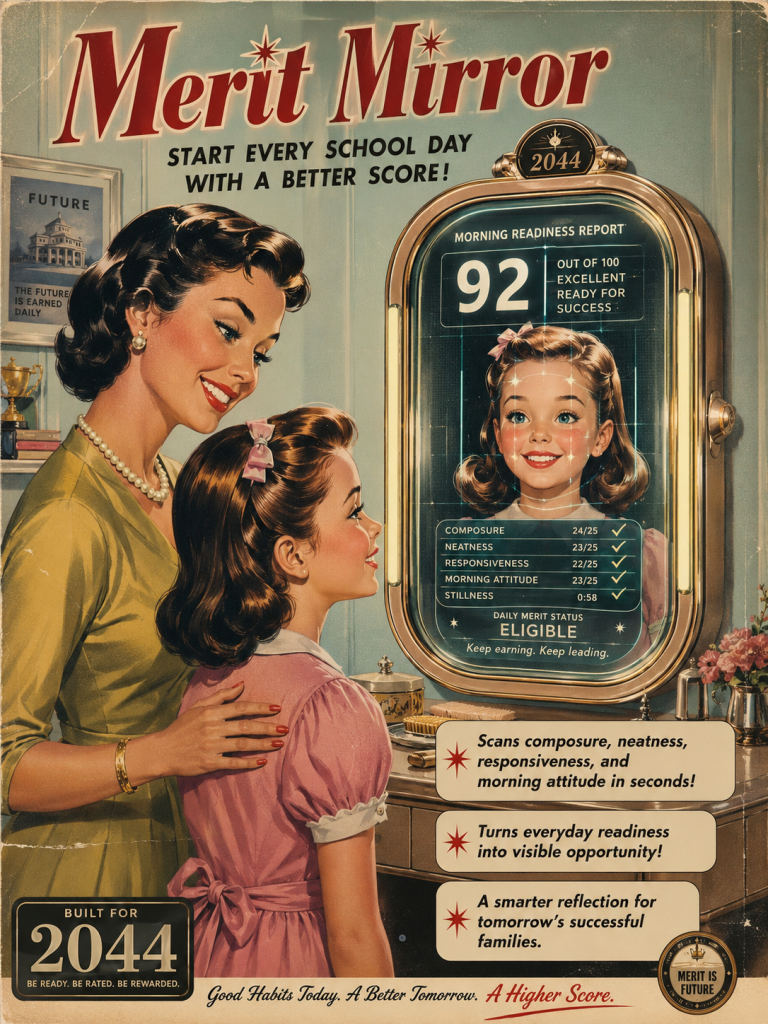
What followed was not a dramatic collapse. Malik stayed in school. He got better at sounding right, calmer, smoother, easier to manage. That was exactly what began to frighten her.
“He got really good at saying what they wanted to hear,” she said. “But he wasn’t growing. He was getting flatter.”
Two said family court judges later cited those evaluations in decisions that sent their children to the Youth Division of White Street MDC.
As Tiana compared notes with other parents, she heard about a deeper layer of the system. Some schools had signed on to discounted “Mental Health Support System” programs recommended by the state. These services were marketed as culturally responsive and evidence-based. Parents later discovered that some were owned by the educational arms of large private prison companies. More than half a dozen told her that, within months of those programs entering schools, students who struggled with the AI behavior systems were increasingly referred for ODD and conduct disorder evaluations. Two said family court judges later cited those evaluations in decisions that sent their children to the Youth Division of White Street MDC.
“It was sold to us as a way out,” Tiana said. “What it really did was decide early who was trainable.”
Tomas Gallien-Phun represented a different afterlife of the system. Raised in Queens, he now lives precariously in the West Village, sustained through a dependency he describes inconsistently as mentorship, collaboration, or support. As a student, he had once been perfectly suited to the system: ambitious, responsive to evaluation, eager to understand what counted.
“There’s still this impulse in me to be legible,” he said. “To say the acceptable version first. Even now.”
By then, he said, students and even staff had a phrase for the system’s harsher edge: “You cross the BMS, you cross the road,” a reference to the Behavior Management System and Crossroads, one of the city’s juvenile detention centers. The joke circulated because everyone understood the warning beneath it.
"There's still this impulse in me to be legible," he said. "To say the acceptable version first. Even now."
Helena Falkenrath, an Upper East Side literature professor and mother of a two-year-old son, opposed the model from the start. She spoke about embodied learning, critical thinking, interpretive judgment, and the importance of live attention and slow conversation in a child’s education. But her objections became urgent when the city selected East 98th Street.
“I object to the premise of this model,” she said. Then she paused. “I also object to its placement.”
That second sentence explained more than the first. For years, AI schools had been concentrated in neighborhoods where families were asked to accept experimentation as improvement. East 98th Street placed that model too close to institutions still protected by small classes, arts education, and human teachers. That proximity changed the politics.
For fourteen years, AI schooling advanced through dashboards, pilot programs, careful language, and unequal distance. On East 98th Street, that distance narrowed. What had once been introduced as a technical solution now looked more openly like a political choice: what kind of education the city is willing to imagine for some children, and what kind it still quietly reserves for others.